

Home / Suffolk / Ipswich

Suffolk's county town

Leak detection in Ipswich for rented homes, flats and shops

Leak detection in Ipswich often starts with someone living elsewhere: a landlord, a letting agent, a shopkeeper with a flat upstairs. We work around who can open up, then find the leak.

Leaks traced from the surface

Written report for owners and agents

Pay by card or bank transfer

Get a quote

Lines open 8am to 8pm, every day.

Ipswich is Suffolk's county town and its largest, at the head of the Orwell estuary. Victorian streets ring the centre, flats now line the old docks, and newer estates stand on redeveloped land. Many homes are let, so whoever opens the water company's letter may live miles from the pipe.

Older terraces bring their own puzzles. Some were plumbed with one supply feeding a row of two or three houses, and a fault anywhere on it troubles them all. Others gained bathrooms at the back, over the kitchen, with pipes hidden in the boards between.

In the centre, plenty of shops have a flat above with its own supply and heating, and water through a shop ceiling might come from there or next door. Our engineer Charlie proves which pipe is losing water before anything is opened, and every party sees the same evidence.

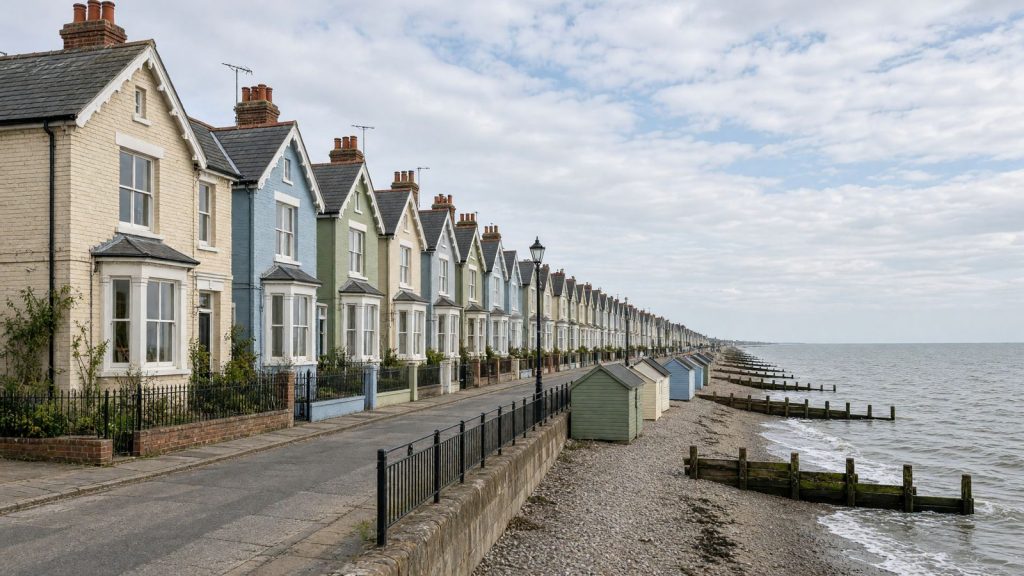
Painted Victorian houses on a seafront road above a shingle beach, typical of the Suffolk coast Brick family homes with gravel drives in a cul-de-sac on the edge of a market town, typical of Suffolk

Typical jobs across Ipswich

Shared supply under the passage between two terraces

The property

Two Victorian terraced houses in the inner town, both lived in by their owners, fed by one old pipe from a single pavement meter that splits under the passage between them.

The problem

Both households had letters about water passing all the time. Neither could find anything wet, indoors or out, and both had checked every tap and cistern.

How we found it

Both stop taps were closed and the pavement meter kept moving, which put the loss on the shared length. The ground microphone peaked under the passage, and tracer gas rose through its paving at the same point.

The outcome

One report went to both households, with the spot in the passage marked and photographed. We quoted the repair separately; how to share it was for the neighbours to agree.

Damp wall behind a shop, from the flat's rising pipe

The property

A town centre shop with a two-bedroom flat above, let separately. The flat's cold supply climbs through a boxed-in corner behind the shop's stockroom.

The problem

The shopkeeper found the back wall damp and a shelf swelling. Upstairs, the tenant had noticed nothing, and a plumber had found no drip under the sink.

How we found it

With that pipe shut off at both ends, a gauge on it fell, so it was leaking. Moisture readings up the boxing then peaked low in the corner.

The outcome

Quoted on its own, the repair went ahead during the visit, through one panel of the boxing at the mark. The landlord sent our report to the building's insurer.

Owners, agents and shopkeepers in Ipswich

Owners and agents letting a property

Your tenant passes on a letter or reports a stain while you are elsewhere. At booking, say who lives there and who pays; absent payers sometimes pay ahead.

Neighbours on one old terrace supply

If your letter lands the same week as next door's, a shared pipe may be at fault. We test each house in turn and mark the leak for both.

Shopkeepers with a flat overhead

A wet stockroom ceiling costs trade. We establish whether the flat's supply, its heating or a neighbour's pipe is to blame; firms can be asked to pay up front.

Shared supply pipes in older Ipswich streets

Anglian Water supplies Ipswich and looks after its main and the pipe up to the meter or boundary. In some older terraces one supply then feeds several houses before branching, and a leak on that shared stretch usually falls to all of them. Shared mains also sit outside the home water leak promise.

Planning the visit around tenants and trade

1

Access and parking

Name whoever opens up and how to reach the meter and stop tap, and mention tenants or trading hours. We also need parking at no charge within 100 m.

2

Testing, tracing, marking

Each pipe is tested until the leaking one shows itself. Its leak is then followed from the surface, and only when a second, different test agrees is the spot marked and photographed.

3

Paying and the paperwork

Card or bank transfer settles the bill at the end; cash and cheques are not taken. Once paid, the written report is sent, and repairs carry a separate quote.

Methods that suit Ipswich buildings

Acoustic listening

A split pipe under pressure makes a steady noise. Heard over a yard, a floor or a boxed-in riser, it peaks above the leak, even through concrete.

Moisture meters

These show how far damp has spread through a wall, ceiling or floor. In a terrace they help separate a front supply leak from a back bathroom one.

Pressure testing

Cutting one pipe off from the rest and reading a gauge settles whether it leaks. Where a shop and flat share a building, it keeps each occupier's pipework apart.

Signs worth a call in an Ipswich home

Letters arriving next door too

When several houses on one old pipe get letters, the shared length is a strong suspect. Note which homes are affected before ringing.

Damp low on a front wall

A tide mark at the foot of the front wall, with dry rooms elsewhere, can mean the supply pipe leaks where it enters.

A stain under the back bathroom

Where a bathroom sits over the kitchen, a stain growing after baths points to a waste or seal; one growing with nothing running suggests a supply pipe.

A tenant topping up the boiler

A tenant who keeps refilling the boiler is often describing a heating leak. Ask how often it happens and pass that on.

Landlords, shops and their insurers

A landlord's buildings policy may include cover for tracing the leak, and the shopkeeper's own policy may cover damaged stock. Check both, as either insurer may want a say before work begins. Our report holds the location, methods, readings and photographs and is released after payment in full. Each insurer makes its own decision.

Common questions in Ipswich

Certainly. Mention the tenant when you book and say who is paying. Your tenant should clear a path to the meter, stop tap and any cupboard hiding pipes. Landlords who stay away may need to pay in advance of the visit.

In most cases. The repair has its own quote; accept it beforehand and that price stands, provided the work is done while we are still there. The 3 month guarantee covers the pipe and fittings we install, not the wider system.

It is. Concrete and paving carry sound well, so a ground microphone can follow a buried supply beneath them; tracer gas helps on plastic. A second method confirms the spot before marking, so only a small patch is broken out.

We do, in new flats and houses alike. Closing loops in turn at the manifold reveals the guilty one; warmed, it shows on the thermal camera, and tracer gas settles the point. Heating work is priced beforehand; no find, no fee on home water leaks does not cover central heating.

Either household can, but testing usually needs access upstairs as well. A managing agent or landlord may be able to arrange that. Readings in your own ceiling narrow the area first, and the report gives both flats the same evidence.

Towns and villages near Ipswich

Kesgrave and Woodbridge lie to the east, Needham Market up the Gipping valley and Hadleigh to the west. Trimley St Mary is on the Felixstowe road, and Manningtree is in Essex.

A pink colour-washed thatched cottage with a picket fence and cottage garden, typical of a Suffolk village

Leak at an Ipswich let or shop?

Call 07700 102 008 about the let, flat or shop. Visits are usually booked within 24 to 48 hours.