
Home / Services / Underground pipe leaks

Buried and long supply pipes

Underground water leak detection for long and buried pipes

A buried pipe across a field, yard or shared drive can leak anywhere along it. We follow it from above, find the leak and mark the spot before anyone digs.

Long runs walked with a microphone

Tracer gas for plastic pipe

Marked and photographed before digging

Repairs guaranteed for 3 months

Get a quote

Lines open 8am to 8pm, every day.

Most houses have a short supply pipe under the front garden. Some have far longer ones: a pipe across a paddock from a meter on the verge, a feed to stables or a garden office, a shared drive, or a main under a business yard. Leaks on these can go unseen for a long while.

For water leak detection underground, the first questions are how long the pipe is and where it goes. A long run nobody has seen since it was laid takes time to follow, so before you book we agree whether the job needs a half day or a full day.

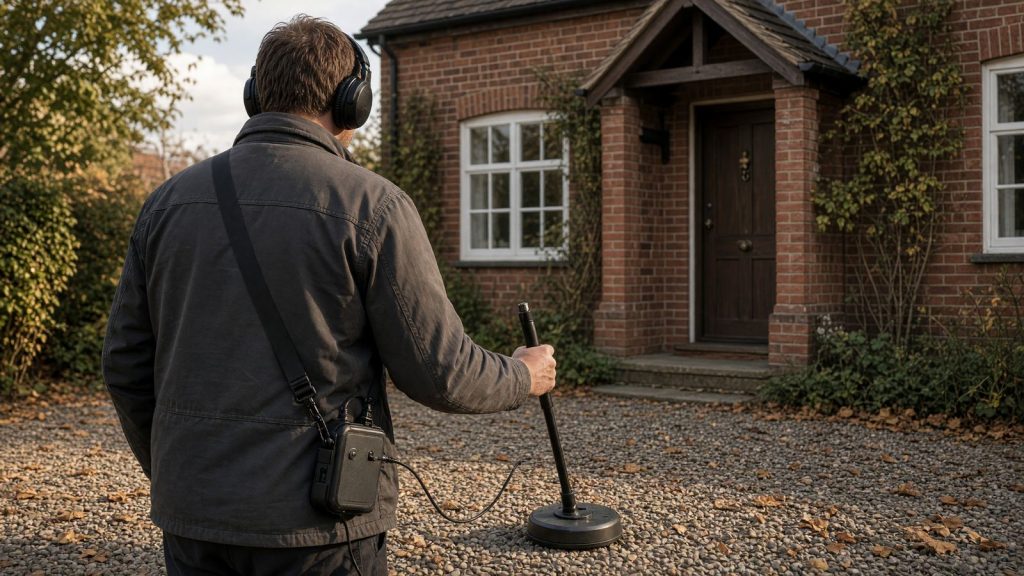
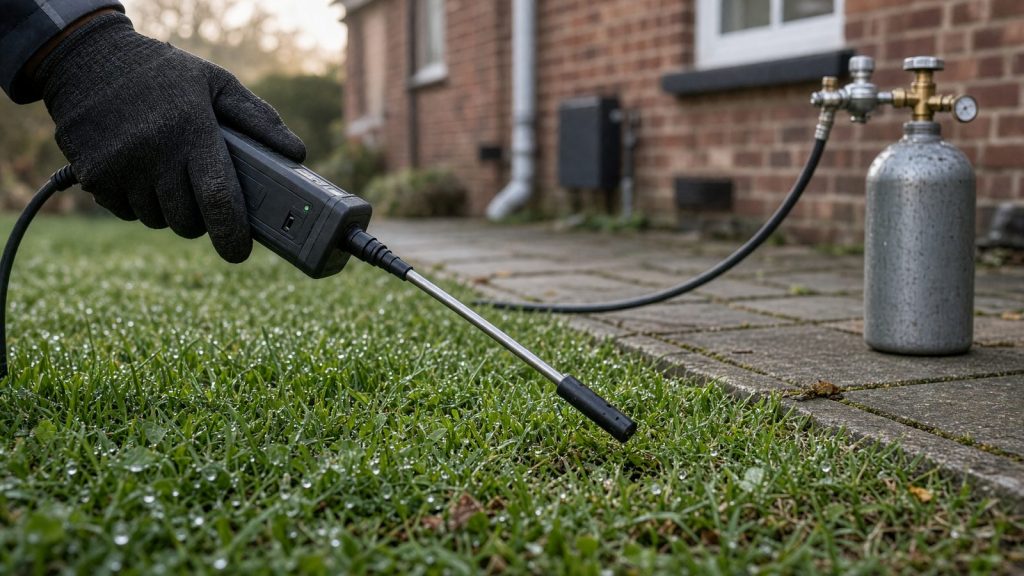
An engineer listening through headphones with a ground microphone on a gravel driveway outside a house A tracer gas detector probe passed over a front lawn, with the gas cylinder on the path beside it

Why long and buried pipes hide their leaks

Underground water leak detection gets harder with distance. A split a metre down can feed the soil for months, or let water run along the old trench and surface far from the leak. Older runs are often black plastic or metal, with joints along them. Newer blue plastic carries little sound upwards, so on those pipes we lean on tracer gas.

An unknown route matters even more than length. If nobody knows where the pipe goes, the search covers a wider strip of ground, and the time it needs is hard to judge by phone. Tell us what you know: old plans, earlier digging, where the pipe enters the house. Underground water leak repair is quoted separately, and work on old pipe can expose other weak spots.

Typical underground jobs we are called to

Fen house whose pipe crosses a drainage dyke

The property

A detached Fen house in Cambridgeshire, reached over a drainage dyke. The supply pipe leaves a roadside meter, passes under the dyke and crosses the garden.

The problem

The water company wrote about constant use, but no wet patch ever showed. The owner dug beside the house and found that end dry.

How we found it

The meter turned with the stop tap shut. Listening was loudest at the dyke bank, and tracer gas surfaced at the water's edge, where the leak had been draining away unseen.

The outcome

The leak was on the garden side of the dyke, so one short dig into the bank reached it. Our report went with the owner's answer to the water company.

Holiday cabins on a coastal Suffolk smallholding

The property

Two holiday cabins at the far end of a meadow on a smallholding near the Suffolk coast, fed by a buried plastic branch from the farmhouse supply.

The problem

Guests mentioned weak showers, and the farmhouse meter turned all night. As the cabins are let as a business, the visit was a business booking.

How we found it

Closing the cabin branch stopped the meter, and that branch alone would not hold pressure. In sandy soil the plastic pipe gave little sound, so tracer gas found the split, and close listening over it agreed.

The outcome

Payment was taken before the visit, as we may ask of business bookings. The split was repaired at the mark during the visit, on a separate quote from the detection.

Essex plant nursery with a main under the car park

The property

A small plant nursery in rural Essex. An old metal main runs under the tarmac customer car park, from the gate meter to the glasshouses.

The problem

The water bill rose while watering stayed the same. Cutting up the car park on a guess would have turned customers away.

How we found it

With every tap and irrigation valve shut, the meter still moved. Metal pipe carries sound, so the leak seemed loud in two places. Tracer gas rising through a crack showed which was right.

The outcome

One square of tarmac was cut at the mark and the car park stayed open. The nursery sent our report and photographs to its insurer.

Signs a buried pipe is losing water

The dial creeps with everything closed

Shut every tap and the stop tap inside. A meter that keeps moving points to a leak on the pipe outside, somewhere between the meter and the house.

A wet strip along a line

A greener or softer band across a lawn, paddock or verge often follows the pipe trench, though its wettest end may not be the leak.

Weak flow at the far building

A stable trough, annexe shower or garden tap losing pressure while the house seems fine points to the buried branch that feeds it.

A gateway or yard that never dries

A puddle on concrete that never clears, or a gateway still muddy when the field is firm, can be water rising from a pipe below.

How we work along a long pipe

1

What we ask before the visit

Where is the meter, and how far is it to the stop tap? What ground does the pipe cross, which buildings does it feed, and does anyone share it?

2

Walking the line

With taps closed and the water on, our engineer Charlie moves along the route with a ground microphone, stopping every few steps. The hiss is loudest over the leak.

3

Tracer gas to settle the point

On plastic pipe, or ground that muffles sound, the pipe is filled with a hydrogen and nitrogen mix that seeps up wherever it escapes. A second method backs it up before we mark and photograph the place.

The three methods we lean on outdoors

Ground microphone

A sensitive microphone on the ground hears water squeezing out of a pressurised pipe. It covers long runs quickly and works well on firm ground and older pipe.

Tracer gas

The pipe is emptied and filled with a hydrogen and nitrogen mix. A detector above ground picks up where it surfaces, even through tarmac or paving.

Pressure testing

On a run with branches, we close sections in turn and see which one cannot hold pressure. Then we listen, or use the gas, on that length only.

Who calls us about buried pipes

Farmhouses with the meter out on the road

The meter may sit on a distant verge, with the pipe crossing grass, yard and hedge. We find out where both ends are, then follow the route on foot.

Owners with outbuildings on the supply

Stables, annexes and workshops often hang off the house supply on a buried branch. If that branch has a working valve, a meter test shows quickly which side is leaking.

Businesses with a pipe under the yard

Units, garages and farm businesses often have a main under tarmac, where cutting on a guess is costly. We find the point first. Businesses may be asked to pay up front.

Insurance and a buried supply pipe

Some home policies include finding a leak on the outside supply pipe; others leave it out. Read the wording, and check whether your insurer wants to approve the visit first. The report gives the location, methods, readings and photographs, and follows once you have paid for the visit. Any claim decision is your insurer's.

Where long supply pipes are common

Long, unmapped supplies are most common in the Norfolk and Suffolk countryside, the Fens, north Essex farmland and Bedfordshire villages. Choose your county below, or ring us for underground water leak detection near you.

Common questions

No set length: you book time, not metres. The agreed price covers a half day or full day of searching, and a long, unclear route may use all of it. A quick find leaves the price unchanged. Route details help the time go further.

Often, but say so when you ring. We work from whatever is known: the meter, where the pipe comes indoors, old trench lines or plans. An unknown route widens the search, and it falls outside no find, no fee on home water leaks; full conditions are on our terms page.

Hard ground does not stop the search. Sound from a pressurised pipe carries up through it, and tracer gas rises through joints, cracks and gaps between blocks. Marking the spot keeps the cut small. Very deep pipes can take longer.

Only if it is no longer than 30 m and its route is known. No find, no fee on home water leaks covers one leak on a water main up to 30 m or the hot and cold supply pipes, at least half a litre a minute, where we also carry out the access and repair. It does not cover central heating, shared mains, businesses or leaks that come and go.

Usually, yes, once the leak is marked. The repair is priced apart from the search, and any repair price we name in advance holds only when the work happens on the detection visit itself. Repairs we make are guaranteed for 3 months on the parts we fit.

Make sure the meter, stop tap and any outbuilding valves can be reached and turned. Check we can get through field and yard gates. Warn us if the pipe passes under a neighbour’s land. We also need somewhere to park within 100 m that costs nothing.

Pipe crossing a field or yard?

Call 07700 102 008 with the rough length of the pipe and where the meter sits. Lines are open 8am to 8pm, every day.