Blue plastic pipe under the garden
Plastic carries little sound, so a leak on a newer supply pipe is hard to hear. Gas needs no noise, which makes plastic its natural job.

For quiet, buried and plastic pipes
When a leak is too faint to hear or sits under a solid floor, we empty the pipe, fill it with a hydrogen and nitrogen mix and trace it from above. Here is how the test runs.
Suits plastic and buried pipe
Results checked a second way
Price agreed before booking
Readings and photographs reported
Lines open 8am to 8pm, every day.
Tracer gas is not usually the first test we run. Listening and the thermal camera are quicker when they work. Gas comes out when the pipe is plastic, the ground deadens sound, the leak is small or the pipe lies in concrete. Some call it hydrogen leak detection, after the gas in the mix.
The test needs some preparation, because the pipe has to be emptied of water before the gas goes in. Knowing the order of things helps you plan the day: which taps will be off for a while, which rooms we need, and what to mention when you ring.
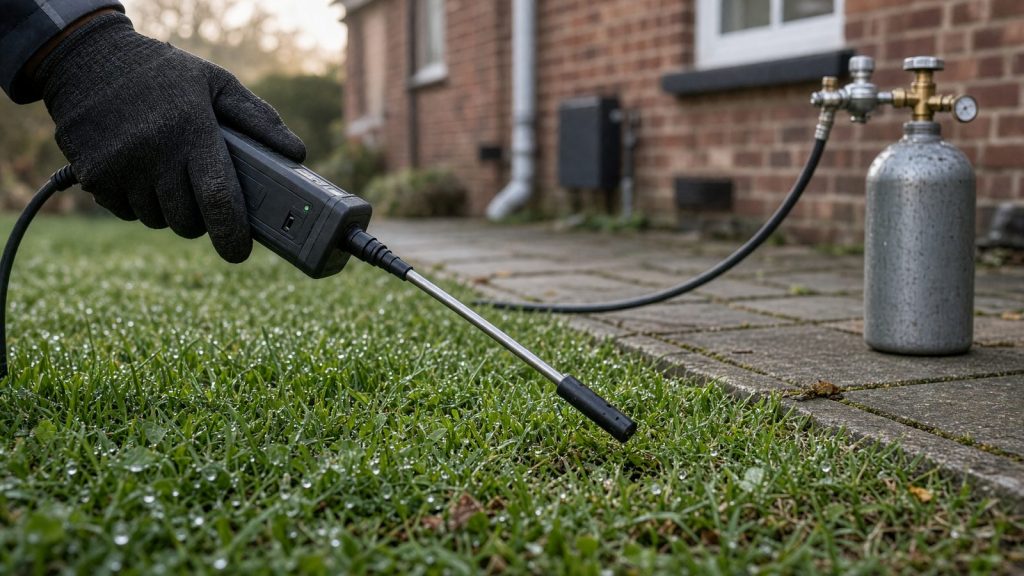
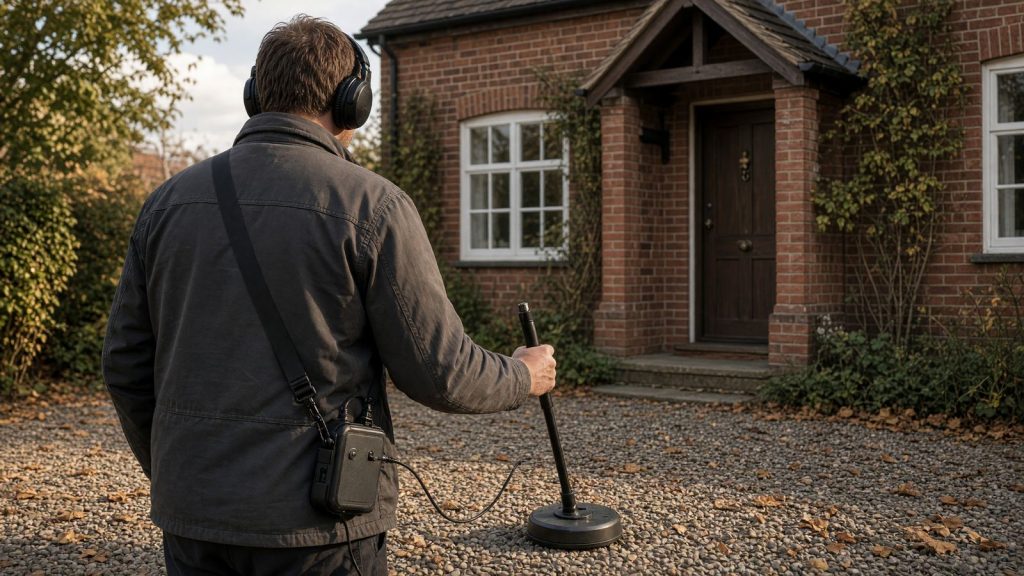
Tracer gas leak detection rests on one idea: gas leaves a pipe through the same gap as the water. With the section isolated and emptied, we fill it with a hydrogen and nitrogen mix under pressure. The gas works up through soil, paving joints or cracks in a floor, and a detector moved slowly over the surface reads strongest above the leak.
The gas has limits. Where pipework runs in ducting, inside insulation or under a membrane, it may surface away from the leak or not at all, so any survey can only narrow the area. Pipework like that sits outside no find, no fee on home water leaks; full conditions are on our terms page. If your floor was built that way, mention it when you ring.
Plastic carries little sound, so a leak on a newer supply pipe is hard to hear. Gas needs no noise, which makes plastic its natural job.
Heating pipes laid in screed, the concrete layer under a floor, can lose water downwards with no damp showing. Filling the isolated loop with gas shows where it gets out.
A small leak makes little noise and leaves little for a camera to see. Gas still slips out of a pinhole and reaches the surface.
If listening left a few possible spots, or none at all, gas narrows it to one, because it only rises where the pipe is open.
The water company has written about a leak, and the pipe from your meter is blue plastic. Listening may pick up little, so we plan the visit around gas.
Heating pipes in screed and underfloor heating loops can leak with every floor looking dry. We test one circuit at a time, then fill only the one that drops.
A long blue pipe across an orchard or field may stay quiet along its whole length. Tell us roughly where it goes, and gas lets us follow it from above.
1
On a supply pipe we close the outside valve and the stop tap indoors; on heating, one loop is shut off. Either way the water comes out, so mention any stiff valves when you book.
2
The empty section is filled with a hydrogen and nitrogen mix. Our engineer Charlie then moves the detector slowly along the route, over floor, lawn or paving, watching for the reading to climb.
3
The strongest reading is only marked and photographed once a second method agrees with it. Then the section is filled with water again and the valves reopened.
Before any gas goes in, the section is pressure tested. If it holds, the leak is elsewhere. If it drops, that length is the one to fill and sweep.
On heating jobs the camera shows where warm pipes run under the floor and where heat is spreading, which tells us which loop to fill.
On supply pipes we listen again over the spot where the gas reading peaked. A faint hiss in the same place is the second method that lets us mark it.
The property
A 2000s detached house in an Essex village. Blue plastic pipe crosses a deep front lawn from the pavement meter to the kitchen, with a branch off it to a garden tap.
The problem
The water company wrote about constant flow through the meter. The owner had walked the lawn looking for a soggy patch and found none.
How we found it
With the kitchen stop tap shut the meter still moved, yet listening found almost nothing. Once the pipe was emptied and filled with gas, the reading rose through the turf over the garden tap joint, and close listening there caught a faint hiss.
The outcome
We lifted a square of turf over the mark and remade the joint before leaving, priced apart from the survey. The owner passed the report on to the water company.
The property
A 1990s detached house in Hertfordshire, with heating pipes laid in the ground floor screed under a tiled kitchen and dining room.
The problem
Topping up had become a twice-weekly chore. A boiler engineer had found the boiler sound, nobody had added sealant, and there was no damp to see.
How we found it
Once the heating had warmed through, the camera picked out a faint warm patch in the dining room. That loop was isolated and emptied, gas went in, and the reading peaked under the tiles a metre short of the radiator.
The outcome
Lifting the few tiles above the mark gave access for the repair, priced on its own. The heating was then refilled and topped back up to pressure.
The property
A bungalow on a solid concrete floor in a Cambridgeshire fen village, with hot water piped under the floor from a kitchen boiler to the bathroom.
The problem
The meter crept overnight and the tiles in front of the kitchen units felt warm underfoot. A new tap washer had made no difference.
How we found it
Once the cold water valve under the boiler was turned off, the dial went still: the loss was on the hot side. With a hot tap running, the camera showed warmth spreading in front of the units, and tracer gas pinned the point.
The outcome
A small patch of floor was opened at the mark and the joint repaired on the day of the detection. The owners kept the report for any claim.
If you plan to claim, speak to your insurer first, because some want to approve the work before it starts. Our written report gives the location, methods, readings and photographs, and reaches you after payment for the visit. Start any opening up where we marked. Paying the claim is the insurer's decision.
We use tracer gas across the region: on plastic supply pipes at newer homes in Cambridgeshire and Bedfordshire, heating in solid floors in Essex and Hertfordshire, and long rural runs in Norfolk and Suffolk.
Call 07700 102 008 with the pipe material, if you know it, and what has been tried. Lines are open 8am to 8pm, every day.