
Home / Services / Underfloor heating leaks

Screed floors and manifolds

Leaking underfloor heating in newer homes, found from the surface

Your boiler keeps losing pressure, but the floor downstairs looks untouched. We check the manifold first, test each loop to find the one losing water, then trace the leak so only a small area is opened.

Manifold checked before the floor

Each loop tested on its own

Repairs guaranteed for 3 months

Get a quote

Lines open 8am to 8pm, every day.

Underfloor heating that runs on warm water from a boiler or heat pump is common downstairs in new homes and extensions. When it leaks, there is rarely anything to see or hear. Escaping water soaks into the screed, the smooth concrete under your floor finish, and for weeks the only clue can be a falling pressure gauge.

Before anything is lifted we need three answers, in this order: is it the manifold, which loop, and where on that loop. Underfloor heating is part of your central heating, so no find, no fee on home water leaks does not apply. The price is agreed up front, sized as half a day's work or a whole day's.

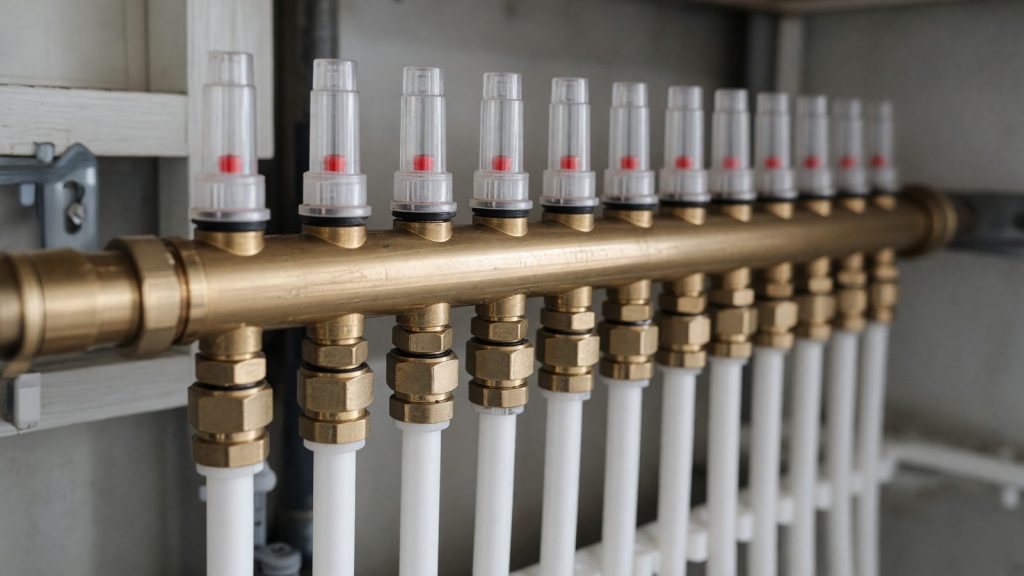
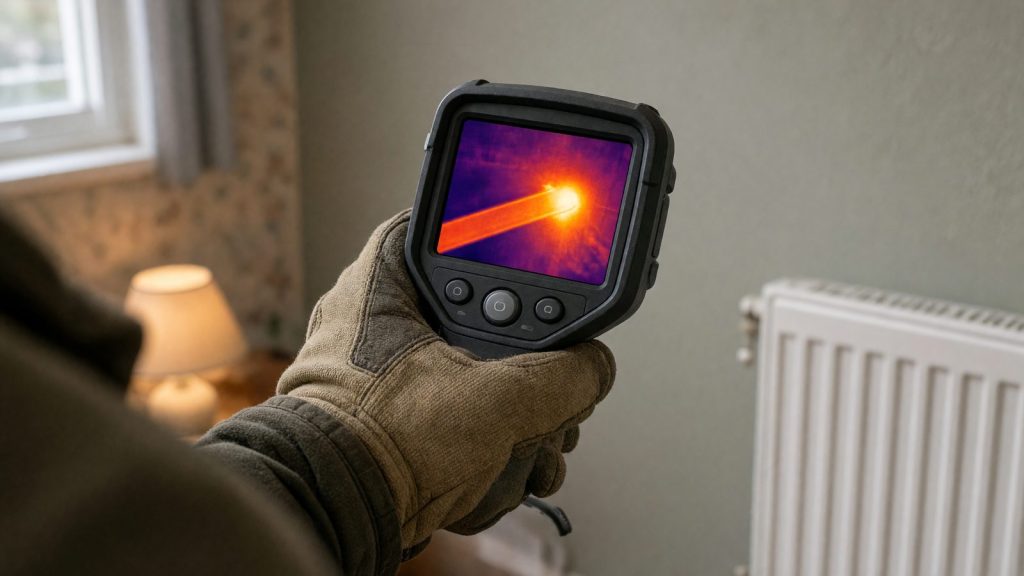
Flow meters on the brass rail of an underfloor heating manifold, with pipes running down to the floor A thermal imaging camera showing the warm line of a heating pipe inside a living room wall beside a radiator

How a wet underfloor system leaks

Leaking underfloor heating usually starts in one of two places. One is the manifold, the bank of valves and gauges in a cupboard where every loop begins and ends, and where most of the joints are. The other is a loop: one long run of plastic pipe in the screed, pierced by a nail or screw, or leaking at a joint added during later building work.

Some pipes are harder to read. Where a loop runs through insulation or ducting, or under a membrane, heat and tracer gas can travel sideways before reaching the surface, so readings may be fainter or offset from the leak. Pipes are often sleeved like this at doorways. If that limits how closely we can mark the point, we tell you on the day.

Typical underfloor heating leaks

Warm tiles by the bifold doors near Braintree

The property

A detached house near Braintree with a tiled kitchen extension. Three underfloor loops heat the extension from their own manifold, while the rest of the house keeps its radiators.

The problem

The boiler needed topping up most weekends. Tiles by the bifold doors felt warmer than the rest, and the grout there stayed dark after mopping.

How we found it

Only one loop failed its test at the manifold. Warmed on its own, it showed a warm bloom by the doors on the thermal camera. Tracer gas then rose through the same tiles.

The outcome

Opening the floor there showed a joint where the loop had been lengthened during the build. It was remade as a separately quoted repair, and the owners had spare tiles.

A weeping manifold joint in a Bedfordshire new build

The property

A house a few years old on a new estate on the edge of Bedford, with underfloor loops downstairs fed from a manifold in the understairs cupboard.

The problem

The pressure fell slowly, needing a top-up every few days. The owner had noticed a damp patch on the cupboard floor and blamed the washing machine behind the wall.

How we found it

We looked at the manifold before testing any loops. Moisture readings peaked under one valve, and once the system was warm, the thermal camera picked out water tracking down from that joint.

The outcome

Nothing in the floor had to be opened. We remade the joint during the visit as a separately quoted repair, and the cupboard floor was left to dry out.

Engineered oak over a heated screed

The property

A south Cambridgeshire barn conversion with engineered oak boards glued straight onto the screed, across a long open-plan ground floor.

The problem

The heating needed refilling most days. Boards near the old cart doors had started to lift at the edges, and the owners dreaded taking up the whole floor.

How we found it

Loop tests at the manifold singled out one circuit. The thermal picture through the oak was faint, so tracer gas located the point and moisture readings in the boards matched.

The outcome

Only the boards over the mark came up, lifted by the owners' floor fitter. The pipe repair was quoted as its own job, and the report went with their claim.

Signs a loop or the manifold is leaking

Pressure loss with everything dry

The gauge keeps falling, yet radiators, valves and visible pipes are dry. A screed floor can soak up a lot of water before its surface shows anything.

One patch of floor warmer than the rest

An area that stays noticeably warmer than the floor around it can be warm water spreading through the screed from a damaged pipe beneath.

Damp coming up through the finish

Grout that stays dark after cleaning, vinyl gone grey or soft in one place, or boards curling at their edges all suggest moisture rising from below.

Crust or damp at the manifold

White crust, green staining or a damp cupboard floor under the manifold point to a weeping joint or valve there rather than a leak in the floor.

Manifold first, then the floor

1

Checks you can make before we come

Look over the manifold with a torch for drips, white crust or staining, and notice whether pressure falls faster when the floor heating runs. Tell us what you spot.

2

One loop at a time

Each loop is closed at the manifold and tested alone. One that cannot hold its reading is leaking, and a loop usually serves a single room or part of one.

3

Warm, trace, confirm, mark

With that loop running warm, thermal imaging follows it through the floor. Tracer gas then pins down the point, which Charlie marks on the floor and photographs for the report.

What each test tells us

Pressure testing at the manifold

A gauge on each closed loop shows whether it holds. It is quick, needs nothing lifted and shrinks a whole ground floor down to one loop to trace.

Thermal imaging

Warm loops show as stripes through tiles, wood or vinyl, and a leak as a blur of heat between them. Tiles and stone give the sharpest picture.

Tracer gas

The loop is emptied and refilled with a hydrogen and nitrogen mix. At the break the gas slips out, works up through the screed and shows on a detector.

Homes where we find underfloor leaks

Owners of new and nearly new homes

Downstairs underfloor heating, push-fit plastic pipe and a cupboard manifold are normal here. When pressure drops, we work out whether a loop, the manifold or something else is to blame.

Households with a heated extension

Extensions often get their own loops, added to an older radiator system. A leak can hide under the new floor or where new pipework meets old.

Owners who need evidence for the builder

If the house is still new, you may want facts before raising it with the builder. Our report gives the location, methods, readings and photographs.

Insurance claims and new-build questions

If you plan a trace and access claim, ring your insurer first, as some want a say before work starts. If the house is new, check with the builder first as well. The report gives the location, methods, readings and photographs, and follows once the bill is settled. Paying out is the insurer's decision alone.

Underfloor heating leaks near you

New estates, barn conversions and extensions on older houses across the region often have underfloor heating that runs on water. For underfloor heating leak detection in your area, choose your county below.

Common questions

Often, yes. A manifold packs many valves and joints into one small space, so an underfloor heating manifold leak is worth ruling out first. A slow weep can dry on the warm pipes before it ever drips. If the manifold is dry, we move on to the loops.

Most likely into the screed. A small leak from a loop can soak into the floor for weeks before the finish shows it. Water can also escape through the boiler’s pressure relief pipe, which runs out through an outside wall, or at a radiator; we rule those out early.

Usually. Each loop has its own valve at the manifold, so a leaking one can often be closed while the others keep heating. A heating engineer can show you which, or we can on the visit. That room stays cooler until the repair.

No. Electric floor heating is a mat of wire with no water in it, so there is nothing to leak or trace; a fault is for an electrician. If your boiler still loses pressure, the leak is likely to be in the radiator pipework, which we can trace.

The finish over the mark has to come up: two or three tiles, a short run of boards or a flap of carpet, then a small patch of screed beneath. Nothing is lifted while we search. Keep any spare tiles or boards, because matching them later is often the hardest part.

We can usually repair it once the screed over the mark is opened, quoted separately from the detection. Repairs are guaranteed for 3 months on the pipe and joints we fit. Relaying tiles or boards afterwards may need your own floor fitter.

Pressure dropping in a newer home?

Call 07700 102 008. It helps to know where the manifold is and what covers the floor. Visits are usually booked within 24 to 48 hours.