A letter about constant use
The water company says readings show water going through day and night. If nothing indoors is wet, the buried pipe outside is where we listen first.

Listening for buried leaks
A pipe leaking under pressure gives off a faint hiss. We pick it up through the ground with a microphone. For that to work the property must be quiet, which is where you come in.
Ground microphone along the pipe
Tracer gas when sound runs out
Spot marked and photographed
Readings set out in a report
Lines open 8am to 8pm, every day.
A listening survey is only as good as the quiet around it. A refilling cistern or a dishwasher mid-cycle sends noise down the pipe we need to hear. So before our engineer Charlie sets the microphone down, every tap and appliance goes off and the meter is read.
Many of these visits start with a water company letter or a meter dial that never rests. Either way, the work runs in the same order: make the house quiet, find out whether the loss is inside or outside, then follow the pipe until the sound peaks.
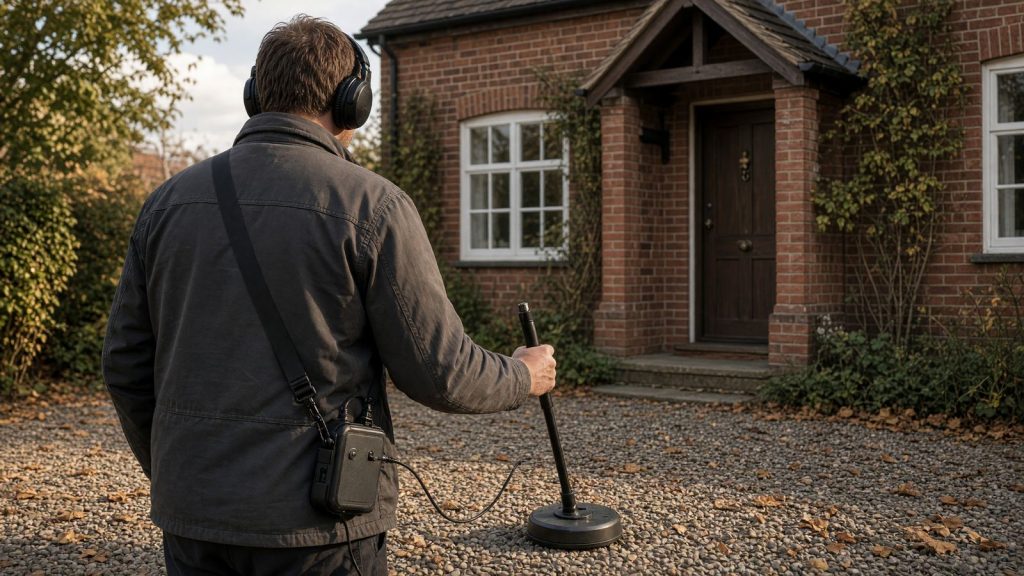
Acoustic water leak detection works because escaping water is noisy. Where a pipe has split or a joint has opened, mains pressure pushes water out through a small gap, and the sound carries up through soil, concrete or paving. Moving the ground microphone a short distance at a time along the pipe's route, we listen for the point where that sound is loudest.
Some conditions make it harder. Traffic, wind, pumps and running water all add noise. Soft or wet ground soaks sound up, and blue plastic pipe carries far less of it than old metal pipe. A very slow leak may make almost none. When listening cannot settle on one clear point, we switch to tracer gas, which does not rely on sound.
The water company says readings show water going through day and night. If nothing indoors is wet, the buried pipe outside is where we listen first.
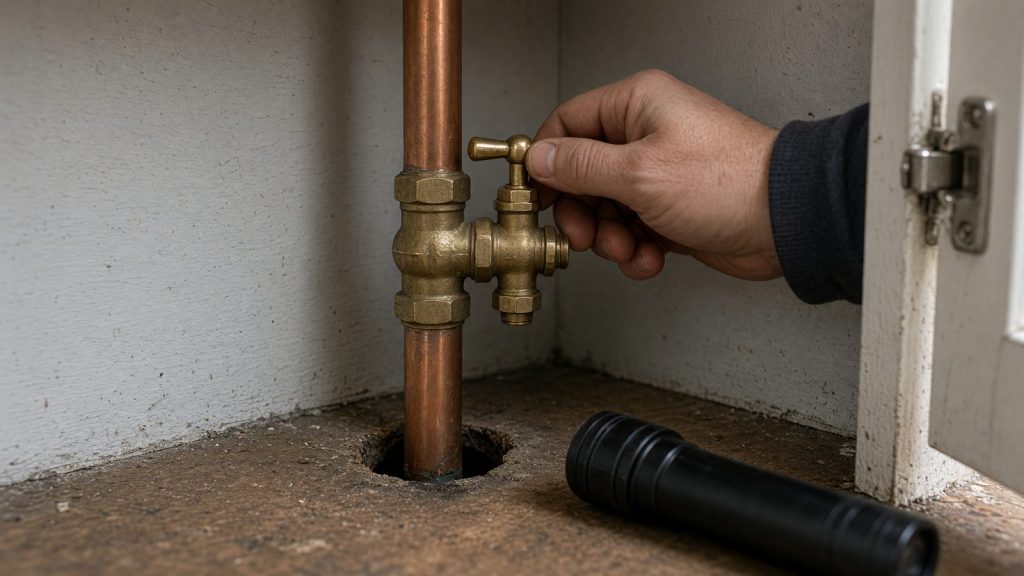
Put your ear close to the stop tap with every tap shut. A steady hiss or trickle means water is moving, and that is the sound we follow.
A narrow band of lusher grass often follows the line of the pipe trench. It hints at the route, which tells us where to start listening.
If all the taps lost force together, water may be escaping before it reaches them. A large split on the supply pipe takes pressure with it.
The water company's readings point to a leak, but the lawn and drive look dry. We check which side of the stop tap it is on, then listen along the buried pipe.
With a meter on a verge or at the end of a track, the pipe may cross a field or two. We walk its route with the microphone, so digging starts at one marked point.
If your policy covers finding a leak, the insurer will want to know where it is and how that was proved. Our readings, mark and photographs answer both.
1
Before we arrive, check nothing is set to run, such as garden watering or a water softener. On the day we shut every tap, make sure no toilet is refilling and read the meter.
2
With the inside stop tap closed, the pipe outside stays under pressure. The microphone goes down at short intervals along its likely line, meter to house, noting where the sound peaks.
3
A loud point is not proof on its own. A second method, often tracer gas or moisture readings, has to agree before we mark the ground and take photographs.
The main tool here. It rests on grass, paving or a solid floor and picks up leak noise from the pipe below. Firm ground and a silent house give the clearest result.
Takes over when listening gives no clear answer, often on plastic pipe. The emptied pipe is filled with a hydrogen and nitrogen mix, and a detector shows where it comes up.
Used where the supply runs under a floor indoors, such as a hall. Readings around the loudest point show whether the floor is damp there too.
The property
A 1950s semi in a Suffolk town. From a meter in the pavement, its supply pipe passes under a long concrete side path to the kitchen stop tap.
The problem
The water company had reported constant use. Every tap and cistern indoors seemed fine, and the owner did not want the whole path broken up.
How we found it
The meter kept turning with the kitchen stop tap closed, so the leak lay outside. We listened along the path and the sound peaked near the back corner, where tracer gas then rose through a crack.
The outcome
A small square of concrete was cut out there and the failed joint renewed, priced separately. The owner then had a report for the water company.
The property
A let Victorian terrace on a busy road in an Essex town. An old metal pipe runs from the pavement meter to a hall stop tap, then under the back kitchen's solid floor.
The problem
The tenant forwarded the water company's letter, and the landlord wanted the leak found before any floor came up. A plumber had found every tap and cistern sound.
How we found it
The dial stopped once the hall stop tap was shut, which placed the leak indoors. Lorries drowned the first readings, so we listened again as traffic thinned. Sound peaked by the old chimney breast, and floor moisture readings agreed.
The outcome
We opened a small patch of floor at the mark and replaced the corroded length, priced separately. The landlord filed the report and photographs with the house paperwork.
The property
A 2000s detached house on the edge of a Bedfordshire village. Blue plastic pipe runs from a roadside meter under a long gravel drive to the kitchen.
The problem
The owner's smart meter showed water flowing all night. Everything inside was dry, and the outside tap and garage sink had been ruled out.
How we found it
Listening gave only a faint, spread out sound: plastic carries little noise and gravel muffles the rest. With tracer gas in the emptied pipe, the reading peaked halfway up the drive, where that faint sound had been strongest.
The outcome
The gravel was raked aside, a small hole dug at the mark and a cracked plastic fitting replaced, quoted separately and guaranteed for 3 months.
Whoever handles your claim needs to see where the leak is and what pinned it down. Our report gives the location, methods, readings and photographs, including where the sound peaked and what confirmed it. It follows once the visit is paid for. Opening up starts at our mark; only the insurer decides on the claim.
Our acoustic leak detection services reach homes across Suffolk, Norfolk, Cambridgeshire, Essex, Hertfordshire and Bedfordshire, from terraces with pavement meters to farms and cottages at the end of long rural runs.
Call 07700 102 008 with the meter's position and a rough distance to the stop tap indoors. Visits are usually booked within 24 to 48 hours.