A bill that rises with use unchanged
When the bill climbs but your use has not changed, the extra is probably escaping. Read the meter at closing and again before opening to check.

Business premises
When a business water bill jumps, a stain spreads under a flat or a yard stays wet, the leak needs finding before anyone cuts into a floor. Here is how a survey of business premises works.
Business terms set out plainly
Sub-metered sites split and tested
Report for landlord or insurer
Pipework repairs quoted separately
Lines open 8am to 8pm, every day.
We survey smaller business premises: a shop with a flat above, a unit on a trading estate, an office suite, or a farm with buildings on one supply. The leaks are the kinds houses get, but more people have a stake: tenants, landlords, agents and the bill payer.
That changes the booking more than the survey. We ask who owns the premises, who will pay and who holds the keys. With a business, we can ask for the money before the date is fixed, cancelling needs a working day's warning or more, and no find, no fee on home water leaks does not apply.
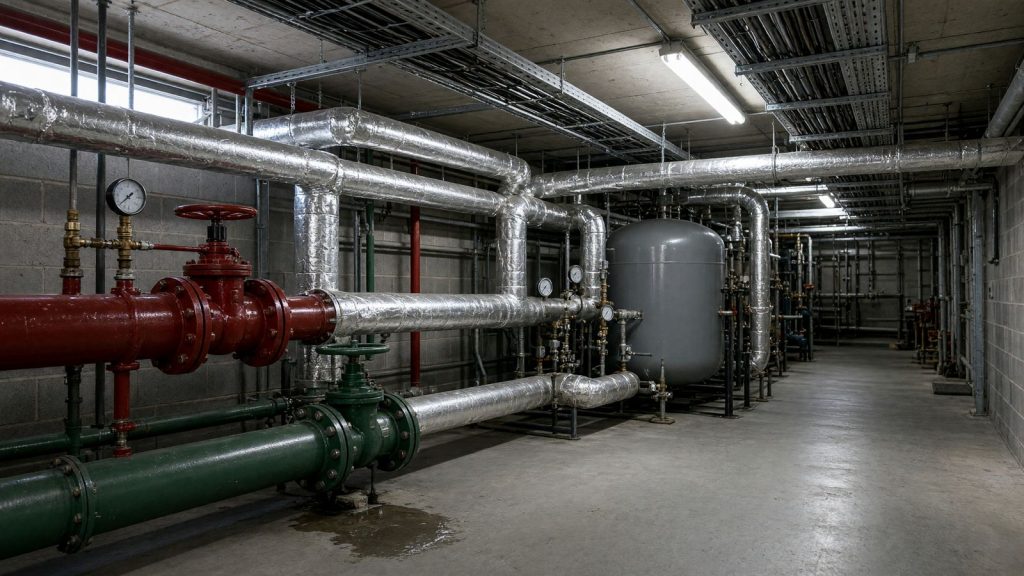
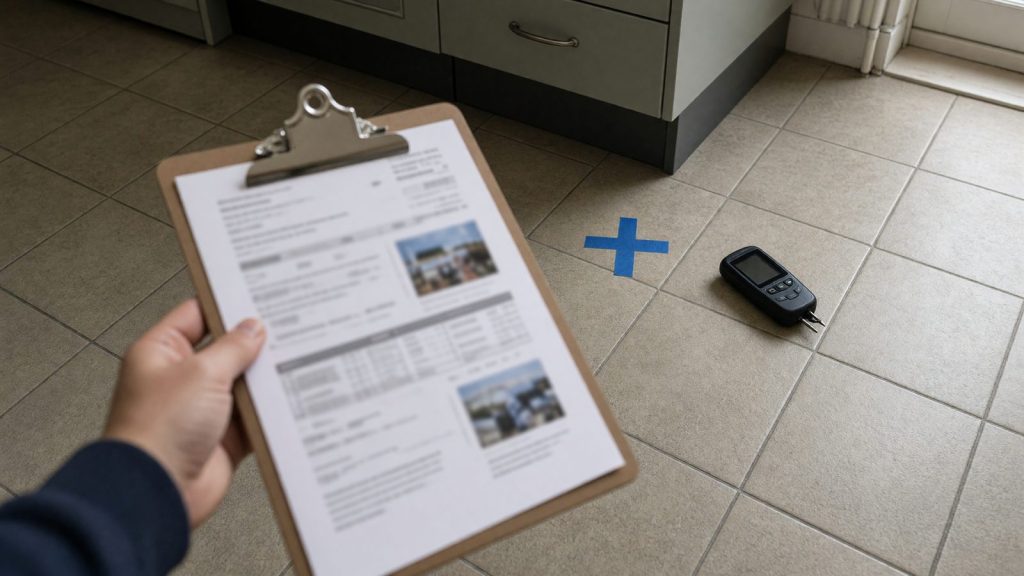
Commercial leak detection starts by working out which part of the site is losing water. One meter often serves several things: a shop and the flat above, a farmhouse and its yard, an office kitchen and the workshop toilets. Where there are sub-meters or valves on each branch, we read and close them in turn, with everything else off, until the main meter stops.
From there the survey is the one a home would get. Supply pipes under yards are followed with a ground microphone and checked with tracer gas. Heating pipes in office floors show up on the thermal camera once warm. Leaks from a flat into a shop are traced with moisture meters and by testing the upstairs fittings one at a time.
When the bill climbs but your use has not changed, the extra is probably escaping. Read the meter at closing and again before opening to check.
If the main meter records more than all the sub-meters together, the missing water is going somewhere between them, often along a buried length nobody watches.
Damp in a ground floor ceiling often comes from the flat or office above, so we start upstairs, with the fittings and pipes over the stain.
An office or showroom boiler that needs regular topping up is losing water somewhere. If the boiler itself is sound, the pipes under a solid floor are a likely place.
The shop may pay the water bill while the flat above has its own fittings and occupants. We find which part of the building is losing water, and so whose pipework it is.
Livestock buildings, workshops and the farmhouse often share a supply, with old pipes under concrete yards. Sub-meters and branch valves show us the losing length before we listen.
If you rent, the landlord or agent may own the pipework. Tell us who is paying when you book. The report, with readings and photographs, can go to whoever arranges the repair.
1
Tell us what the site is, whose it is and who pays; we may ask for payment before confirming. We need to reach meters, valves, ceilings and yards, and to park within 100 m without paying.
2
Sub-meters and valves split the supply, showing the length that is losing water; then we trace the leak itself and check it a second way. A mark and photographs show where any repair should begin.
3
Unless you paid up front, payment is taken as the visit closes, and the written report follows once it is settled. If you want the leak mended, we price that job on its own.
On a site with branches to several buildings or units, we close off each section and test it on its own. Whichever fails to hold pressure is where the search carries on.
Useful in offices and showrooms with heating pipes in the floor. With the heating warm, the camera shows where hot water is spreading under carpet tiles or vinyl.
A ground microphone on concrete yards and tarmac picks up a pressurised leak on the pipe below. The loudest point is confirmed, then marked as the place to start cutting.
The property
A shop in a Suffolk market town with a self-contained flat above, both on one meter. The shop pays the bill; the flat is let separately.
The problem
The shop's bill had jumped, and the plaster high on the stockroom's back wall had darkened. A plumber had found the shop's own toilet and sink sound.
How we found it
With the flat's stop tap shut, the meter stood still, which put the leak upstairs. Moisture readings led across the flat's kitchen floor, and listening found the loudest point under the sink unit.
The outcome
The report placed the leak on the flat's own supply. With the building's owner agreeing, we repaired the pipe under the sink unit while we were there, quoted separately.
The property
A mixed farm in Norfolk, with the farmhouse, a workshop and cattle buildings on one metered supply. Each has a sub-meter, and old metal pipes cross a concrete yard.
The problem
Metered use had jumped with no change in stock or washing down. Nothing was wet inside, and the yard showed no puddle to give the leak away.
How we found it
The sub-meters fell well short of the main meter, and closing the cattle branch stopped it. Listening found a hiss by the shed entrance, and tracer gas rose through a joint there.
The outcome
Concrete was broken out only at the mark to renew the joint, which was quoted separately. The farm filed the report alongside its water bills.
The property
A small industrial unit in Cambridgeshire, with a workshop behind and an office in front. A wall-hung boiler heats the office through pipes laid in its screed floor.
The problem
Most mornings the boiler needed topping up, and the carpet tiles felt warm near reception. The tenant had already had the boiler serviced.
How we found it
Pressure testing the office circuits in turn showed the floor circuit dropping. With the heating warm, the camera showed heat spreading by reception, and moisture readings in the screed agreed.
The outcome
The report went to the tenant and the landlord's agent, showing where the floor needed opening, with the repair priced separately for the landlord's approval.
Rented business premises are often covered by the landlord's buildings policy rather than the tenant's, so check whose policy applies before you book. Some insurers ask to approve the work in advance. Our written report gives the location, methods, readings and photographs, and follows payment for the visit. Whether to pay a claim is for the insurer.
Our commercial leak detection services cover shops, farms, offices and units across Essex, Hertfordshire, Bedfordshire, Cambridgeshire, Norfolk and Suffolk, from market town high streets to trading estates on the edge of larger towns.
Call 07700 102 008 with the type of site, who owns it and who is paying. Lines are open 8am to 8pm, every day.