
Is the water really coming through the wall from next door?
Water coming through the wall from next door may be from their pipes, but it can also be your own pipes, rain or the ground. Check your own side first, then talk to your neighbour, because finding the source usually means testing both homes. Terraced and semi-detached houses share one wall, called the party wall, so a leak in either house can show on it.
Your own pipes may run along the party wall as well. Many terraces are built as mirror-image pairs, so the kitchens and bathrooms of two houses often sit back to back across it. Shut every tap and watch your meter: if it moves, the leak could be yours. A falling boiler gauge points to your heating. Outside, where the two houses meet, look for a blocked shared gutter, or soil or a path built up above the damp-proof course, the waterproof layer near the base of the wall.
Clues from timing and pattern
Keep a simple note of when the patch is wetter and when it dries. A patch that darkens each morning around the time next door showers points to their bathroom. One that spreads after their washing machine runs points to its waste pipe or hoses. A patch that grows steadily day and night, whatever anyone does, suggests a pipe under pressure on a supply or heating circuit.
Height and shape help too. Damp high on an upstairs wall suggests a bathroom or a cold water tank in their loft. Damp in a band along the bottom of a downstairs wall points to the ground, the floor or a buried pipe. A patch that only appears after heavy rain usually comes from outside, often a shared gutter, a downpipe or the chimney stack the two houses share.
Talking to your neighbour
Knock early and keep it friendly, with photographs on your phone. Most people want to know if their home is leaking, because a leak can damage their side too. Ask whether they have seen any damp, a meter that keeps moving, a boiler that needs topping up or water bills going up. Ask them to try the meter test with every tap off. Their answers often narrow things down quickly.
If the house next door is rented, the landlord or letting agent is the one who can arrange testing and repairs, so ask your neighbour for their details. If it is empty, the owner or their agent can usually give access. Keep notes of what was said and agreed. If you cannot agree, a community mediation service can help, and if it turns into a real dispute, speak to a solicitor.
Shared supply pipes in terraces
In many older terraces, such as those in parts of Norwich, Ipswich and Colchester, one supply pipe comes off the water main and feeds several houses. The branch to each home can run under a neighbour's front garden, hallway or floor. So a leak on your neighbour's side of the wall can sit on a pipe that also feeds your house. Where a supply pipe is shared, the owners it serves are usually responsible for it together.
Signs of a shared supply include a single stop tap that turns off more than one house, or your pressure dropping when next door runs a bath. Your deeds may show how the supply is laid out, and the water company named on your bill may be able to tell you about the pipes it looks after. If several homes share one meter, a meter test only works when every household agrees to use no water.
Agree with your neighbour before anyone closes a shared stop tap
Tell everyone on the supply when testing is planned
Keep copies of any letters the water company has sent
Ask each household to note when their pressure drops
Getting both homes tested
Finding a leak in a party wall usually means getting into both houses. When you book, tell us the pipes may pass into or beneath the house next door, and whether it is owned or rented. Whoever makes the booking agrees the price with us in advance and settles the bill once testing is done; we take cards and bank transfers, though not cash or cheques. The other household only needs to let us in. We need the rooms either side of the wall, both stop taps and any meters.
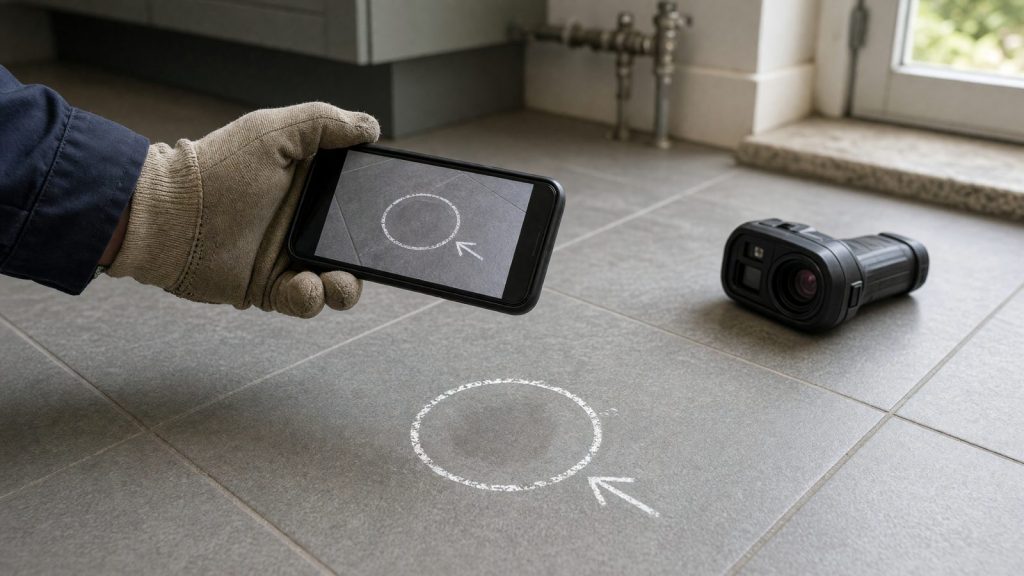
On the day, we map the damp on your side with a moisture meter, then test from next door. Their shower, bath, basin and washing machine are run one at a time while someone watches your wall. Supply and heating pipes are pressure tested to see which one loses water. A buried shared supply is traced by listening along its route with a ground microphone, then checked with tracer gas, a hydrogen and nitrogen mix. Only when two methods agree is the spot marked and photographed.
Insurance and the report
Tell your own insurer as soon as you see damp, before any repairs. Home policies often cover escape of water, meaning damage caused by water leaking from pipes or appliances, and some include trace and access, which helps with tracing a hidden leak and reaching it. Your neighbour should tell their insurer too. Which policy pays for what depends on the cause and the policy wording.
You get a written report with the location, methods, readings and photographs, showing where we found the leak and on which pipe. It reaches you when the bill for the visit is cleared, and you can pass it to your neighbour and both insurers. Paying a claim is the insurer's decision alone. Start opening up at the mark: the pipe has to be seen before anyone can say for certain that the leak is there.