


Home / Essex / Billericay

Old town and suburbs

Leak detection in Billericay

Billericay's oldest buildings can still have iron or lead supply pipes, while newer homes hide underfloor heating. We work out which you have, then trace the leak from the surface.

Old metal supply pipes traced

Underfloor heating loops tested

Supply pipe repairs quoted separately

Get a quote

Lines open 8am to 8pm, every day.

Georgian and Victorian buildings still stand in Billericay's old centre, on high ground in south Essex. Around them, the town grew into a London commuter suburb of semis and detached houses, and newer homes have since been added at its edges, some with underfloor heating.

Leak detection in Billericay often begins with the age of the supply pipe. In the oldest buildings it may still be lead or iron, which can fail anywhere along its length. Newer houses bring different leaks, in plastic pipe and underfloor heating beneath tiles or wood.

A narrow street of Victorian red brick terraced houses with a church tower at the end, typical of an Essex town White weatherboarded cottages with picket fences along a village street, typical of Essex

Typical Billericay jobs, cellar to heated floor

Damp cellar wall below a Georgian house

The property

A Georgian house in the old town with a brick cellar. Its old iron supply comes in through the front cellar wall from the pavement.

The problem

A damp patch on the cellar wall kept spreading, and everyone assumed groundwater. Then Essex and Suffolk Water wrote about constant use.

How we found it

With the cellar stop tap shut the meter still crept round. Listening along the wall and pavement line peaked by the front step, where tracer gas agreed.

The outcome

Opening beside the step found the iron pipe corroded through. The repair was priced on its own, and the owner sent the report with a reply to the water company.
Pressure loss under engineered wood floors

The property

A newer detached home where the town meets the fields, heated by underfloor loops beneath engineered wood throughout the ground floor, with a manifold in the hall cupboard.

The problem

Every few days the boiler wanted more water, yet no floor felt wet. Tightening the manifold had made no difference to the falling gauge.

How we found it

Closing the loops one by one at the manifold showed the lounge loop alone losing pressure. Warmed up, thermal imaging found heat spreading by the patio doors; tracer gas pinned it.

The outcome

A few boards by the patio doors came up for the repair, which was priced separately, while the rest of the ground floor was left as it was.

The Billericay homes behind our calls

Owners of old town buildings

A lead or iron supply can be older than anyone living there. Where it comes in through a cellar or front wall, damp there is often blamed on groundwater first.

Households with underfloor heating

Pressure that keeps falling with no damp in sight often points to one loop under the floor. We test the loops one at a time from the manifold cupboard before anything is lifted.

People claiming trace and access

An insurer usually wants evidence before agreeing to any opening up. Our written report pins down the leak's position, the tests used and the readings taken.

Lead and iron pipes and Essex and Suffolk Water

Billericay's water comes from Essex and Suffolk Water. Its part ends at the meter or the boundary line, so a leak between there and your kitchen is normally the owner's to put right, whatever the pipe is made of. In the oldest buildings that run may well be lead or iron.

Three steps on a Billericay visit

1

Tell us how old the house is

When you ring, we ask the house's age, the meter's position and whether there is underfloor heating. Those answers often point to the right pipe early.

2

Meter first, then the gauge

With everything off, a moving meter means the supply is leaking and a sinking boiler gauge means the heating is. The stop tap then splits indoors from out.

3

Locate, confirm and photograph

Our engineer Charlie chases the leaking pipe with whichever test suits it, then checks with a second. The spot is marked and photographed for whoever carries out the repair.

How we trace Billericay leaks

Acoustic listening

Iron and lead ring with the noise of escaping water, which makes the ground microphone a strong first tool in the old town. The sound peaks right above the leak.

Thermal imaging

With underfloor heating running, warm loops show as stripes on the camera through tiles or wood. A leak blurs warmth beyond its stripe, and that blur is what we look for.

Tracer gas

We use it to confirm what the other tests suggest. A hydrogen and nitrogen mix goes into the emptied pipe, slips out at the fault and is detected at floor or ground level.

When the insurer wants to see the readings

A trace and access claim usually needs proof of where the leak is and why a floor, path or wall had to be opened. The written report gives the location, methods, readings and photographs, and we release it once payment has cleared. Check your policy first: only the insurer decides whether it pays.

Common questions in Billericay

Not if the leak is on the main itself, which belongs to the water company along with its pipe to the meter or boundary. Water escaping between that point and your house is usually on your pipe, and that is the part we trace.

In most cases. With the leak confirmed, we give the repair a price of its own, which stands only if the work happens while we are still on site. If the pipe is lead, ask about replacing the failed length when you book.

Not for the finding. We test the loops separately from the manifold, warm the floor and scan it with the thermal camera, then confirm with tracer gas. Pipe under insulation or a membrane can hinder any survey, and we will warn you if that applies.

Once the visit is paid, by card or transfer when we finish. It shows where the leak is, how we traced it, the readings we took and our photographs. Deciding whether to pay out rests with the insurer alone, not with us.

We do, as well as the town itself, Ramsden Heath and Shenfield. Visits are usually booked within 24 to 48 hours, and lines are open 8am to 8pm, every day. When you call, say which village you are in and where your meter sits.

Beyond Billericay

Ingatestone lies to the north-west and Shenfield to the west, with Brentwood beyond. Wickford and Runwell are to the east and Basildon to the south, while Stock and Ramsden Heath are the nearest villages to the north.

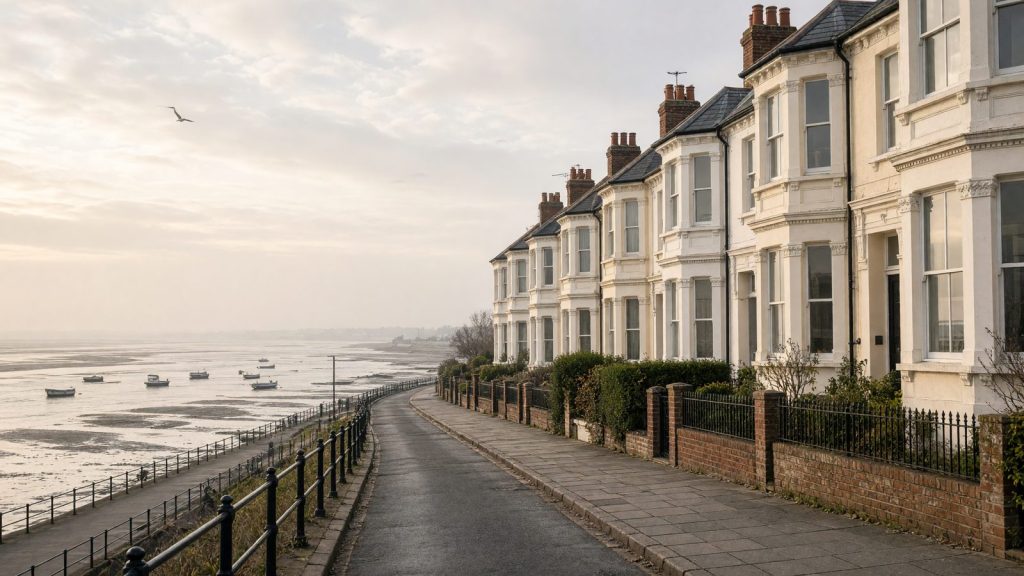
Victorian bay-fronted houses on a hillside road above an estuary, typical of an Essex seaside town

Old pipe or new floor in Billericay?

Call 07700 102 008 between 8am and 8pm, any day. Visits are usually booked within 24 to 48 hours.