

Cambourne's newer homes

Leak detection in Cambourne for newer homes and underfloor heating

Leaks in Cambourne homes hide in push-fit joints, underfloor loops and pipes set in screed. We find the leaking loop or length first, then the point on it.

Underfloor loops tested one by one

Shower leaks tested part by part

Floors opened only at the mark

Repairs quoted before work starts

Get a quote

Lines open 8am to 8pm, every day.

Cambourne is a new settlement on former farmland west of Cambridge, so almost all its homes are modern. Leak detection in Cambourne means modern systems: plastic push-fit pipework, sealed heating with a gauge on the boiler, and underfloor heating fed from a manifold in a cupboard.

Those systems are generally reliable, but a joint that lets go under screed can soak away beneath without marking the surface. The first clue is usually a boiler needing refills, a meter that will not settle, or one strip of floor warmer than the rest.

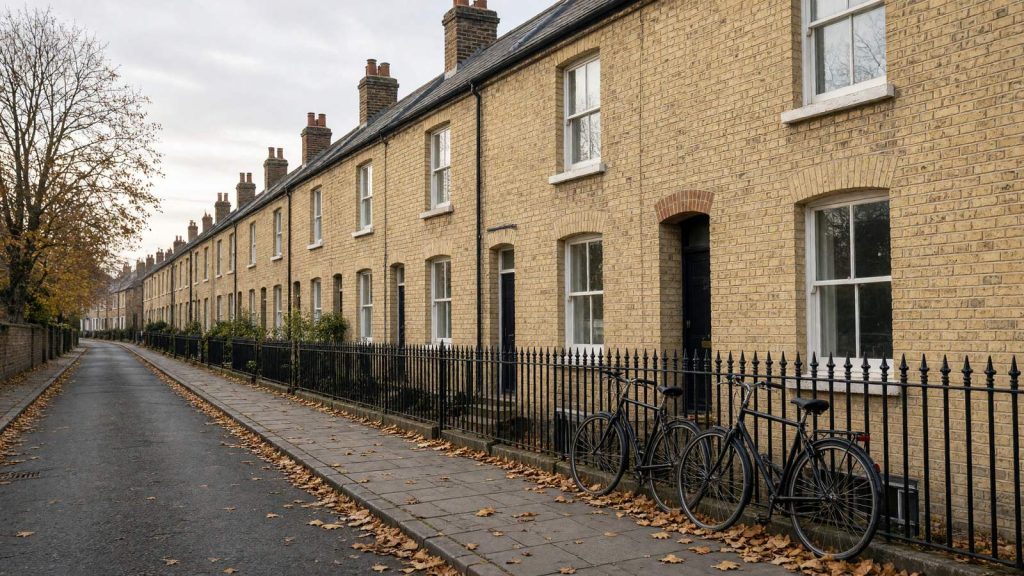
Pale gault brick Victorian terraced houses with bicycles at the railings, typical of Cambridge New-build brick and timber-clad townhouses with solar panels and young street trees, typical of a Cambridgeshire estate

Typical jobs in Cambourne homes

Every underfloor loop held, yet the pressure kept falling

The property

A detached house heated through the floor downstairs, with two pipes in the screed linking the utility room boiler to the manifold.

The problem

The boiler lost about a bar every few days, with no damp anywhere. A plumber had tightened every manifold fitting, and nothing changed.

How we found it

Each loop held when tested alone, but the two boiler pipes did not. With the heating on, the thermal camera followed them to a warm spread under the kitchen tiles, and tracer gas agreed.

The outcome

Photographs and a mark on the tiles fixed the spot. Lifting a few of them gave access for a repair with its own quote, and no loop was disturbed.

Damp wardrobe behind a newer en suite shower

The property

A town house from a later phase, with an en suite built of stud walls and a fitted wardrobe backing onto the shower.

The problem

Clothes at the back of the wardrobe smelled damp and its skirting had swollen. The tiles looked sound, and no stain showed downstairs.

How we found it

The meter stood still with everything off, so the supply pipes were sound. Moisture readings peaked behind one tray corner and rose only when water hit it. On the thermal camera, warm water there spread into the wall.

The outcome

The failed seal at that corner was marked and photographed. No tiles came off: the owners' own tiler resealed the tray, guided by our photographs.

Cambourne homeowners we help

Homes heated through the floor

If the pressure drops but the floor looks perfect, we start at the manifold, shutting off loops singly until one gives itself away, then follow it with the thermal camera.

Owners whose boiler gauge keeps dropping

Often the boiler itself has been checked and passed. We ask how fast the gauge drops and whether sealer went in, then split the system.

New owners with a high water bill

A meter that keeps moving in a newer house can mean a hot or cold pipe leaking into the floor. Stop tap readings tell us which.

The meter box and the pipe beyond it

Cambourne is supplied by Cambridge Water. On newer streets the meter often sits in a small box by the drive or set into a front wall. The company looks after its main and the short pipe to that box; from the box to your stop tap, usually blue plastic, the pipe is normally yours.

Three questions, answered in order

1

Which system is losing water?

Meter readings with the stop tap open and shut, the hot side isolated, and the heating gauge watched alone, show which of the three is losing water.

2

Which loop or run?

Underfloor loops are closed at the manifold and tested one by one. Radiator circuits and hot runs are isolated where valves allow, until one length still drops.

3

Where exactly on it?

With heating or hot water running, the thermal camera follows that length to the warm spot. Tracer gas or a pressure test confirms it before we mark it.

How we see under a modern floor

Thermal imaging

Once heated, underfloor pipes and hot runs show on the camera as bright stripes. A leak blurs one into a widening patch, unless thick insulation or a membrane masks it.

Tracer gas

The loop or pipe is emptied and a hydrogen and nitrogen mix fed in. Escaping where the pipe has failed, it rises through screed and tiles until our detector catches it.

Pressure testing

Each loop is filled, sealed and watched on a gauge. Any loop that holds is ruled out, which is how a house full of pipework narrows to one length.

Around Cambourne

Papworth Everard, Caxton and Bourn are close by. St Neots and Potton lie to the west, St Ives and Godmanchester to the north, and Histon and Cambridge to the east.

A lone brick house beside a straight drainage channel on flat black fields, typical of the Cambridgeshire fens

Check the limit on your trace and access cover

Trace and access cover may carry its own limit within a home policy, and relaying tiles over screed is a big job. Check that limit, and ask your insurer whether it wants to approve the work first. Our report gives the location, methods, readings and photographs, showing why the opening went where it did.

Common questions in Cambourne

That is the aim. We trace from the surface, so opening up for the repair starts at one marked spot. Insulation, ducting or a membrane under the pipes can limit any survey, and we will say if that applies to yours.

No. It does not cover central heating, shared mains, businesses or leaks that come and go, and underfloor heating is heating. Instead, a half or full day price is agreed before booking, and it is not reduced when the leak turns up early.

Sometimes, but not always. A weep at a manifold valve can be a small separate fault while the real loss is on a loop under the floor. Testing each loop on its own shows which, so nothing is replaced on a guess.

Watch two things. If the boiler’s pressure gauge keeps falling, the heating is losing water. If the meter creeps round while every tap is off, the supply or hot water pipes are. On the visit we confirm which by isolating each in turn.

Ring once topping up becomes routine, because water lost from the heating is going into the floor or walls. Visits are usually booked within 24 to 48 hours. Meanwhile, keep the pressure where your boiler manual says and note how fast it falls.

Gauge dropping in Cambourne?

Tell us how often you top up. Call 07700 102 008; lines are open 8am to 8pm, every day.