
Before the visit: the questions we ask and why
On a leak detection survey we search for a hidden leak without breaking into floors, walls or the ground. The visit opens with tests that show which pipe is losing water. It moves on to tracing the leak with equipment such as a ground microphone, a thermal camera or tracer gas. It ends once a second method has backed up the first and the spot has been marked and photographed, with a written report to follow.
It starts with a conversation, by phone or email. We want a picture of the problem and the building, because that decides which tests to bring and how much time to allow. If your boiler keeps losing pressure, we ask how often you top it up. If a letter from the water company prompted the call, we ask roughly how long the pipe from the meter is. We also ask if it is a home or business premises, and about any leak sealant in the heating.
Say so as well if the property belongs to someone else, if another person is paying, or if pipes cross into, or pass beneath, the house next door. A shared pipe, a tenant who will open the door or a landlord settling the bill each changes how the visit is set up, so they are far easier to plan around at the start than on the doorstep.
Booking and what the price covers
You get a price for the detection by phone or email before anything is booked. The figure pays for one of two blocks of searching, up to half a day or up to a whole day, depending on the job, and finding the leak in the first few minutes does not reduce it. Materials needed on the day are charged at cost, and so are any parking or toll charges.
Visits are usually booked within 24 to 48 hours, on a date and time we settle together, and card details secure your slot. Booking by phone, email or our website as a consumer gives you 14 days to change your mind and cancel. Businesses, and anyone cancelling after those 14 days, need to let us know at least one working day before the visit.
On the day: access, parking and the stop tap
Testing relies on a stop tap and valves that actually turn, so find yours before the day and try them gently. We may need the loft, the rooms the pipes pass through, the garden or drive and the water meter, cleared as far as is sensible. Our engineer also needs a parking space that costs nothing, 100 m from the door at most. This short list covers most of it:
Find the stop tap and check it turns
Know where the water meter is
Clear the loft hatch, cupboards and pipe runs
Check for free parking within 100 m
Note when the boiler was last topped up
Have any letter from the water company to hand
Finding the leak, then checking it
The first job is to split the problem in two. On a supply pipe, reading the meter twice with every tap off, once with the stop tap open and once with it closed, shows whether the water is going inside or outside. On a heating system, a pressure test shows whether it is losing water and, with sections shut off, which part. Under a bathroom, moisture meters map how far the damp has spread before any fitting gets the blame.
Then the search narrows. A thermal camera shows warm heating pipes in floors and walls once the system has been running. The ground microphone listens through the surface for the hiss of a pressurised pipe giving up its water. Tracer gas, a hydrogen and nitrogen mix, goes into a pipe too quiet to hear, and our detector finds the point where it seeps out of the ground or floor. Nothing is lifted or opened up to look.
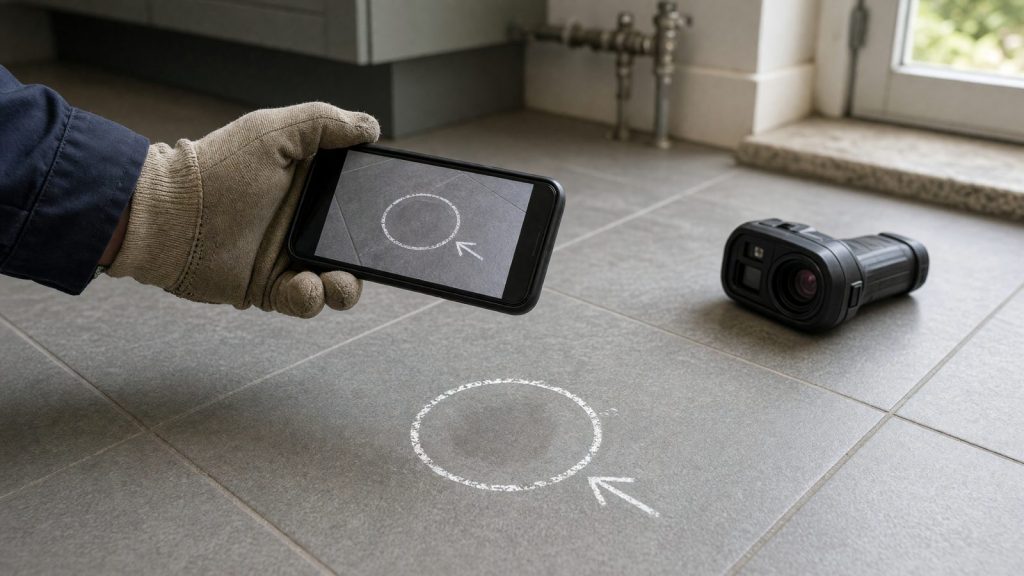
A single reading never earns a mark. Once one method has found the leak, a different method has to agree with it. When the two line up, the spot is marked and photographed, and those photographs and readings become the heart of the written report, so anyone reading it later can see how the spot was chosen.
What counts as found on a leak detection survey
Our terms count a leak as found when it has been narrowed to one room, or to a patch of floor or ground roughly 5 m by 5 m. The mark itself is a single spot inside that. Because it comes from equipment above the surface, it is the place to begin opening up, and no leak is proven until someone has exposed it.
No find, no fee on home water leaks covers one leak on a water main up to 30 m or the hot and cold supply pipes, at least half a litre a minute, where we also carry out the access and repair. It does not cover central heating, shared mains, businesses or leaks that come and go. Visits outside it are charged at the agreed price whatever happens, and so are visits where wrong information about the job stopped us finding the leak. Full conditions are on our terms page.
Water leak detection surveys sometimes show that nothing is leaking at the time of testing. That is still useful to know. Damp can come from condensation, poor ventilation or rising damp, a falling pressure gauge can point to a fault in the boiler itself, and a water meter can be faulty, so the next call may be to a different trade.
Payment and the report
The bill is settled as the visit ends, by card or by bank transfer, and cash and cheques are not accepted. A business, or a payer who cannot be at the property on the day, may need to pay before the visit, and we confirm the slot once that is done. That can apply to a landlord whose tenant is letting us in, or an executor dealing with an empty house.
Once the bill is fully settled, the written report goes out. It covers the location, methods, readings and photographs, and it is written so it can go straight to an insurer as part of a trace and access claim. Your insurer decides on the claim, not us, so read the policy first: some insurers ask to approve the work before anyone books it.
If you want the repair done while we are there
Once a leak on pipework has been found, we can usually mend it as well, with a separate quote for that work. A repair price quoted beforehand only holds if the mend happens while we are there that day, so it helps to decide early whether you would like the pipe put right before we leave.
Our repairs are guaranteed for 3 months from the day they are done. The guarantee covers what we installed, the new pipe and fittings, and does not stretch to the rest of the system. Pipe in poor condition can give way at other weak points after a pressure test or a repair, and that work is priced separately. If your pipes are old, say so when you book.