
Why a long water supply pipe leak is different
A long water supply pipe leak is traced the same way as any buried leak: listening from the surface, then a second method to confirm. What changes is the scale. The meter at the road counts every litre lost between there and the house, so a high reading points to a leak without saying where on the run it is. Most of that run is usually the owner's pipe, not the water company's.
Long runs are common across rural Norfolk and Suffolk, in the Fens where homes sit at the end of a drove, and on farms in Cambridgeshire and north Essex. Many were laid long before the present owners arrived, then patched in places, so one run can be part old black plastic, part metal and part newer blue pipe. Some also feed troughs, stables, a garden tap or a second cottage.
Water does not always come up where it leaks. It often follows the loose soil of the old trench, so a wet patch can appear metres away from the hole. In light, sandy ground it may soak away and never show at all, which is why a long-run leak is often only noticed through the meter or a letter from the water company.
What we ask before we come
On the phone, our engineer Charlie will usually want the distance from the meter to your indoor stop tap before anything else. A rough figure in metres is fine. After that, the questions are about the route, the ground and anything else the pipe feeds, because each answer changes which method we start with and how long the search is likely to take.
Old plans, a builder's drawing or the spot where the pipe was last dug up all help. So does a line in the grass that looks different from the field around it. If the pipe serves another household, tell us, because a shared supply sits outside our home water leak promise. If it also feeds a business, such as a farm shop or a livery yard, tell us that too, so we can say which terms apply. Have these answers ready when you ring:
Roughly how many metres from the meter to the house
What lies on top: field, track, concrete yard, tarmac or lawn
What the pipe looks like where it rises at the stop tap
Any valve or stop tap partway along the run
Branches to outbuildings, troughs, field taps or another home
What the meter does with everything turned off
Walking the line with a ground microphone
Water squeezed out of a buried pipe makes a steady hiss in the soil. A ground microphone picks that up from the surface. We set it down at intervals along the likely line and compare the readings: the sound builds as we close in on the leak and fades once we pass it. On a long run, the loudest stretch is narrowed first, then the point within it.
Some ground helps and some does not. Concrete and compacted tracks carry the sound well. Soft or waterlogged soil, a pipe laid deep and plastic pipe all weaken it. Background noise matters too: a road, a pump, machinery or livestock nearby. Where there is a valve partway along, closing it while someone watches the meter shows which side of the valve is losing water before we listen at all.
Tracer gas on plastic runs
Runs laid or renewed in recent decades are usually plastic, and plastic carries the sound of a leak far less well than metal. A small leak on a plastic pipe can be almost silent at the surface. That is where tracer gas comes in. We put a hydrogen and nitrogen mix into the pipe. The gas finds its way out wherever the pipe is split and drifts upward through the earth, where our detector catches it above the run.
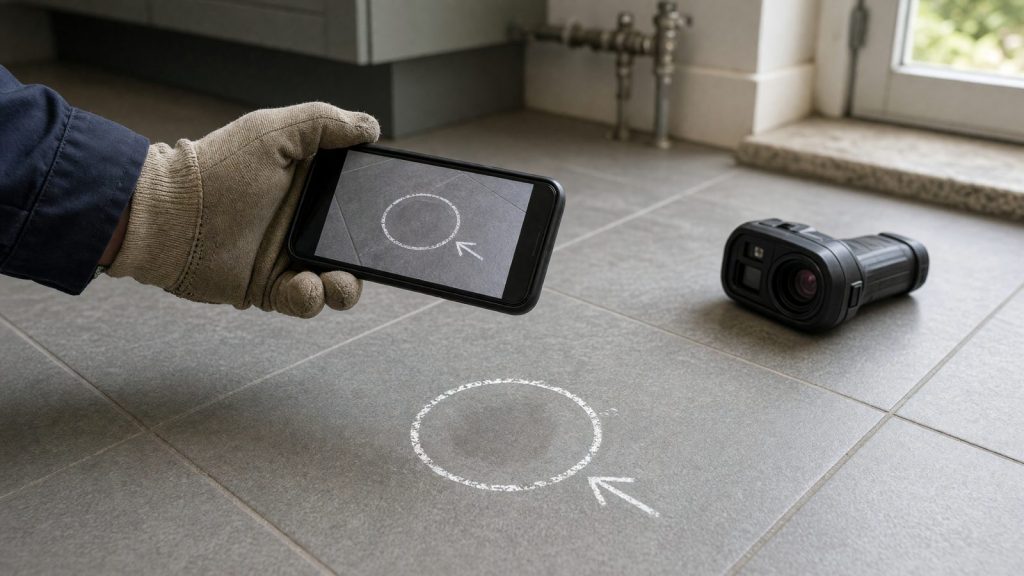
We walk the route with the detector, along the line the microphone suggested or the one you have given us. Under concrete or tarmac the gas can take longer to come up and may surface at a joint or crack, so we compare the gas reading with what the microphone heard before committing to a spot. Once the two agree, the position is marked on the ground and photographed for whoever will dig.
Price and preparation for a long run
No find, no fee on home water leaks covers one leak on a water main up to 30 m or the hot and cold supply pipes, at least half a litre a minute, where we also carry out the access and repair. A run longer than 30 m falls outside it, and so does a pipe whose course across the land is not known, or one that also serves another property. Full conditions are on our terms page.
Your price comes by phone or email before any date is fixed. It pays for our time, with the quote naming the limit: a half day's or a full day's searching, set by the length of pipe and the ground. A quick find does not make it smaller. Materials, and any parking or tolls, go on the bill at cost. Because a long run sits outside the promise, the agreed price applies whether the leak turns up or not, so give us the fullest picture you can.
On the day, it helps to have keys ready for any locked gates, outside lids cleared, stock and dogs kept away from the route, and every stop tap and valve working. If the pipe crosses a neighbour's land or runs under it, let us know at the booking stage, so that the neighbour can agree access before we arrive.
Repairs across fields, yards and verges
The marked spot is where digging should start, though no leak is proven until the pipe is uncovered. We can usually repair a leak on a buried run, priced on top of the search. A repair quoted before the visit only holds if the mend is done while we are on site on the day of the detection. Every repair we make is guaranteed for 3 months, but only for the joint or new length we fit, not the whole run back to the road.
Old runs bring a particular risk. Pressure testing or mending pipe that is already worn can make it leak somewhere else along the run, and we quote separately for any work on those new leaks. Opening up a yard, a fence line or a verge can also disturb nearby pipes and surfaces, so it is worth knowing what else runs through the ground before anyone digs.
If the water company wrote to you, tell it when the pipe is mended and ask whether it offers an allowance for the water lost. If you plan to claim, check that your policy covers underground supply pipes or trace and access before you book. The written report gives the location, methods, readings and photographs, and we send it to you once the search has been paid for in full.