
The quick check, and why the side matters
The quickest way to find out whether you have a hot water leak is to shut off the hot side on its own and watch the meter. Hot water starts life as cold mains water, so a leak on either side makes the meter move. Close the feed into your boiler or cylinder, and a meter that stops tells you the water is escaping from a hot pipe or the appliance itself.
Knowing the side changes how we look. When a hot tap runs, a leaking hot pipe warms the floor above it, so a thermal camera can follow its route. A cold pipe gives off little heat, so we listen for it or use tracer gas instead. It can change who you call, too: water escaping from inside the boiler or cylinder is a job for a heating engineer.
Clues in the house that point to a hot water leak
Some clues depend on how your home heats its water. With a hot water cylinder, a store of hot water is kept ready, so a leak on a hot pipe draws warm water out all the time. You might notice one patch of floor that stays warm with the heating off, hot water running out sooner than it used to, or the boiler or immersion heater running more.
A combi boiler, the kind with no hot water tank, works differently. It heats water only when it senses enough flowing through it, so a slow leak on a hot pipe may never make it light. The water escaping is then cold, and the floor above it feels no warmer than the rest. A faster leak can make a combi fire up when nobody has a hot tap on, which is worth noting down.
One warm spot underfoot on tiles or vinyl
Flooring lifting or stained with no spill to explain it
A combi lighting when no hot tap is running
A loft tank that refills with every tap off
A meter check with the hot water off and on
This check takes about 20 minutes and, at most, a flat screwdriver. Find the water meter first, then the valve on the cold pipe that feeds your boiler or cylinder. Under a combi it is one of the pipes at the bottom, often labelled, with a small lever or a screwdriver slot. On a cylinder it sits on the cold pipe running in near the base.
If your hot water comes from a cylinder fed by a tank in the loft, be patient. The meter only moves when that tank tops itself up, so the result can lag behind by several minutes. If any valve is stiff, leave it. Forcing an old valve can start it weeping, and we can run the same checks on the day.
Switch the boiler or immersion off before you close the valve, as a simple precaution, and open it again before anyone runs a hot tap. The steps below assume your meter sits outside, in the pavement, drive or garden. If yours is indoors, the last step tells you less, because an indoor meter cannot see the buried pipe.
Turn off every tap, appliance, hose and water softener
Watch the meter for 5 minutes and write down the reading
Close the cold valve into the boiler or cylinder, wait 10 minutes, read again
No change: the leak is on the hot side or in the appliance
Still rising: open that valve, shut the main stop tap, watch again
Stops now: a cold pipe indoors. Still moving: the buried pipe outside
Heating pipes and hot water pipes are not the same
Hot water pipes carry the water you use at taps, showers and baths. Heating pipes form a separate loop: the same water travels round and round between the boiler and the radiators, and none of it comes out of a tap. Both run warm and they often share a floor, wall or cupboard, which is why a warm patch alone cannot tell you which one is leaking.
The clue is where the water goes missing from. On heating with a pressure gauge on the boiler, a leak makes that gauge fall, so you keep topping it up, while the meter barely moves. A hot water pipe leak does the opposite: the meter turns and the boiler gauge holds steady. Older heating with no gauge is topped up from a small loft tank, so watch whether that tank keeps refilling.
The difference matters on the day. No find, no fee on home water leaks does not cover central heating, so a heating visit is paid at the price we agree up front, whether or not the leak turns up. If anyone has added leak sealer to the heating, mention it when you ring, because sealer can stop our tests from working.
Hot pipes in floors and why the camera finds them
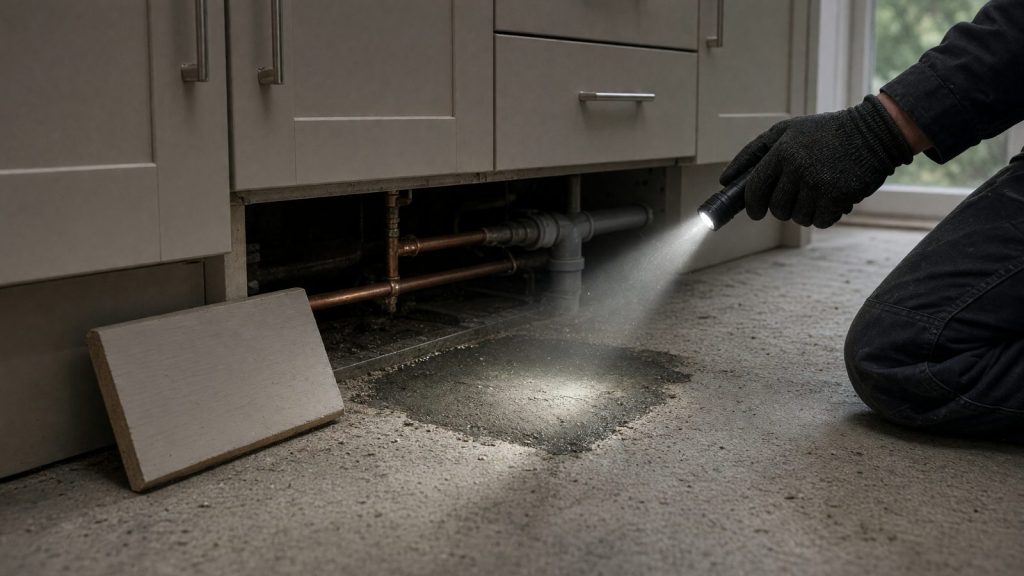
Bungalows and houses with a solid ground floor, common on post-war estates and across the fens, can have hot pipes running inside the concrete under tiles or laminate. Many extensions are built the same way. A thermal camera reads the temperature of the surface, not the pipe, so it needs warm water moving. We run the hot water for a while and the route of the pipe starts to show as a warm line. At a leak, the warmth spreads into a patch.
The camera has limits, and you should know them before the visit. It sees little through thick carpet and underlay, a deep concrete floor or pipes wrapped in insulation, and it is little help on a pipe carrying cold water. So any warm spot is checked with a second method, often tracer gas, a hydrogen and nitrogen mix pumped into the pipe so a detector on the surface can find where it comes out. Only then do we mark the floor and photograph the mark.
Opening up should begin at that mark, but nobody can be certain of a leak until the pipe is uncovered and seen. We can usually mend it while we are there, priced on its own. A repair price given beforehand stands only if the mending happens on that visit, so ask for it early. Our repairs are guaranteed for 3 months, covering the pipe and fittings we fit.
What to do next
If the check points to a hot pipe, you can slow the loss by closing the valve into the boiler or cylinder whenever you can manage without hot water. Switch off the immersion or the boiler's hot water while it is closed, and watch for damp spreading. When you ring, tell us whether the meter stopped, what kind of boiler or cylinder you have, and what the floors are made of where the pipes run.
Before you book, we talk the job through and agree what it will cost, for either half a day of tracing or a whole day. Finding the leak in the first hour does not lower that figure. The water will be off at times while we test, so plan showers, washing and cooking around the visit.
Your insurer and our home water leak promise
Ring your insurer early if the leak has marked a floor or the ceiling below. Ask if the policy has trace and access cover, the part of some policies that deals with locating a hidden leak, and if they must approve who does the work. We send a written report with the location, methods, readings and photographs once the visit is paid in full. Only your insurer can say whether the claim is paid.
Hot and cold supply pipes can come under our promise. No find, no fee on home water leaks covers one leak on a water main up to 30 m or the hot and cold supply pipes, at least half a litre a minute, where we also carry out the access and repair. It does not cover central heating, shared mains, businesses or leaks that come and go. Pipes in ducting or wrapped in insulation are excluded too, and hot pipes are often wrapped. Full conditions are on our terms page.