
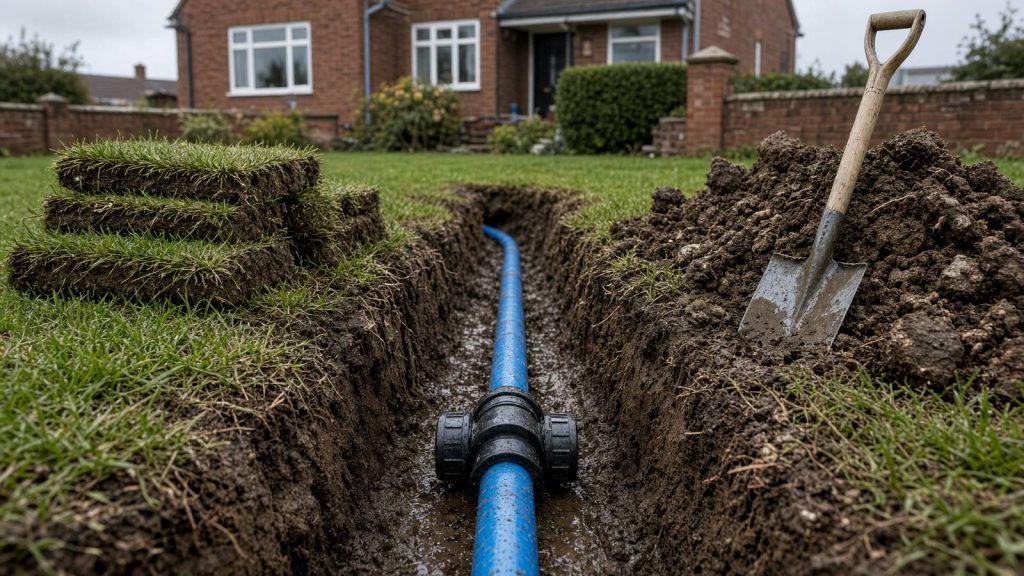
Who is responsible: the water company's pipe and yours
When you find a water leak in your garden, who is responsible depends on which pipe is leaking. Everything up to your boundary, including the main beneath the road, is the water company's to maintain. Past the boundary, the pipe that carries water under your garden to the house is usually yours. So a leak under your lawn, path or drive is most likely yours to put right.
Many homes have a stop tap at the boundary, under a small lid in the pavement or by the front gate, often in the same chamber as the meter. That fitting is normally where the company's pipe ends and yours begins. This split of water supply pipe responsibility applies to most homes, but check the details with your own water company, because the position of fittings varies from street to street.
Pipes that branch off your supply to feed an outside tap, a garden irrigation system, a pond or an outbuilding are yours too, wherever they run. They are easy to overlook, because they are often laid shallow and forgotten. If the outside tap has its own small valve indoors, closing it is a quick way to rule that pipe in or out.
Clues to which side the leak is on
The meter is the most useful clue, as long as it sits outside at the boundary. With nothing indoors using water, lift the lid and watch the dials for a few minutes. If they move, close your indoor stop tap and look again. A boundary meter still turning with your stop tap shut means water is leaving the buried pipe between them. That length is normally yours. An indoor meter cannot show this, because a leak under the garden loses the water before it reaches the meter.
Wet ground can mislead. Water follows the easiest path through soil, so a soggy patch can appear a few metres from where the pipe is actually leaking, even across the boundary. If a boundary meter stays still, the water is probably not from your supply pipe. It may come from the company's pipe, from a neighbour's, or not from the mains at all: rain off a patio, a blocked soakaway or a broken rainwater pipe.
Water rising through the pavement or road: report it to the water company
Clear water filling the meter chamber in dry weather: ring the company first
A wet or sunken strip between the boundary and the house: likely your pipe
A greener line of grass in a dry spell: often a pipe below
Boundary meter still with everything off: probably not your supply pipe
Shared supplies and long runs
In some older terraces and on shared drives, one supply pipe feeds several homes before it splits. The owners it serves generally share responsibility for the shared length, while each looks after the branch that serves only their own house. Your deeds may say more. Talk to your neighbours early, because testing a shared pipe means turning the water off for everyone on it.
On farms, barn conversions and cottages down a track, the meter often sits by the road, far from the house. The pipe from the company's meter or stop tap to your house is still usually yours, even if it runs under a paddock or next door's drive. Runs over 30 m, shared pipes and pipes whose route nobody knows fall outside no find, no fee on home water leaks. Those jobs are priced before you book, and that price pays for a fixed spell of searching, whatever the outcome.
What to ask your water company
Ring the number on your bill and ask plainly. Policies differ from one company to the next, so its answers are the ones that count for your home. Have your account number, your meter readings with the time of each one, and any letter the company sent to hand. Write down who you spoke to and what they said, because the answers shape what you do next.
If they say the leak is on their side, it is theirs to look after. If they say it is on yours, the next step is to find exactly where. Do not count on any allowance until the company has confirmed it in writing. These are the questions worth asking:
Is the leak on my side of the boundary or yours?
Will you check the meter and the boundary stop tap?
What is your leak policy for customer supply pipes?
Is there an allowance on the bill once the leak is fixed?
What proof of the repair will you want to see?
Finding and fixing a leak on your side
Digging up a lawn or a drive on a guess often means digging in the wrong place. Our approach starts above ground. A ground microphone moved along the pipe's likely route picks up the sound of escaping water. For quiet leaks and plastic pipe, we use tracer gas, a hydrogen and nitrogen mix, which seeps out where the pipe is damaged and is traced at ground level. We wait for a second, different test to point at the same patch of ground before we mark it and take photographs.
The first thing we will ask is how many metres of pipe run from your meter to the stop tap inside, and what covers them. Check too that your indoor stop tap still turns, because the tests need it. Repairs to the pipe are usually possible, with their own quote, and our repairs are guaranteed for 3 months.
No find, no fee on home water leaks covers one leak on a water main up to 30 m or the hot and cold supply pipes, at least half a litre a minute, where we also carry out the access and repair. It does not cover central heating, shared mains, businesses or leaks that come and go. Full conditions are on our terms page.
Insurance for supply pipes
Some home insurance policies cover underground supply pipes. Others include trace and access cover, which applies to the work of finding and reaching a hidden leak, and some cover neither. Read the policy wording, or ring your insurer, before you book anyone, since some insurers like to agree who carries out the work before anything is booked. Supply pipe cover is also sold on its own, so check what it includes before you rely on it.
If you claim, your insurer may ask to see exactly where the leak sits and what equipment found it. Our written report gives the location, methods, readings and photographs, and it is yours once the visit has been fully paid. Paying out on the claim is a decision for your insurer alone. Landlords should look at their own buildings policy, since the supply pipe is part of the property rather than the tenant's belongings.