
How a water leak in an empty property comes to light
If you find a water leak in an empty property, close the stop tap, photograph the damage, tell your insurer and get the leak found before any floors or walls are opened. Most of these leaks come to light in one of four ways: a letter from the water company about high use, a bill far bigger than an empty house should run up, a neighbour who spots water outside, or a visit that turns up a stain or a wet floor.
Empty homes hide leaks well. Nobody runs a tap, so nobody notices weak pressure or hears a pipe hissing. Nobody walks across the damp floor or sees the stain spreading, so a slow drip can soak in for weeks. In East Anglia, that often means second homes on the Norfolk and Suffolk coasts, cottages by the Broads, flats between tenants, and houses left empty after a death while the estate is sorted out.
Checks before a property is left empty
Ten minutes before you lock up can save weeks of damage. Find the stop tap and try turning it. It is often under the kitchen sink, but in older houses it can be in a cellar, under the stairs or in a cupboard in the front room. An old stop tap that is stiff, or will not shut off fully, is worth having replaced while nobody is living there.
Some owners shut the stop tap every time they go, and some policies expect it. A central heating system holds its own water, and shutting the stop tap does not empty it. If the house will stand empty through cold weather, ask your insurer what they want done about the heating, and ask a plumber about draining the pipes down.
Write down the water meter reading as you leave
Check toilet cisterns and the loft tank are not running into an overflow
Look under sinks and behind the washing machine for drips or marks
If the water stays on, leave the heating ticking over on low
Leave a key, and the stop tap's location, with someone close by
The cleanest meter test there is
An empty house gives you the clearest meter test you will ever get, because nobody is using water. Read the meter when you arrive, use nothing that draws water, and read it again before you go. If the figure has moved, water is escaping somewhere. Many meters also have a small dial or marker that turns when even a trickle passes through, which makes a slow leak easier to spot.
Next, split the house from the supply pipe. Close the stop tap indoors, wait half an hour, and read the meter again. Movement with the stop tap closed puts the leak outdoors, somewhere under the garden, drive or path between the meter and the house. That length of pipe is usually the owner's responsibility. If the meter stops, the water is going somewhere indoors. One warning: an old stop tap that does not close fully lets a little water past and can make the meter creep.
Indoors, the usual causes in an empty house are quiet ones. A toilet cistern with a worn valve can trickle into the pan all day. The float valve in a loft tank, which shuts the water off when the tank is full, can stick and send water out through an overflow pipe on an outside wall, where nobody is around to see it. If nothing like that is running and the meter still turns, the leak is probably hidden in a floor or a wall.
Access when you cannot be there
The person paying does not have to be at the property. Someone has to open up for us and lock the door when we finish, and that can be a neighbour, a key holder, a letting agent or a relative. We need to get into every room and the loft, round the outside, and to the meter, stop tap and valves. The stop tap and valves have to work, because testing means opening and closing them.
When you book, tell us if the property is not yours, for example an estate you are handling or a flat you manage for an owner, and tell us if someone else is paying. If whoever is paying cannot attend, we may take payment up front, before we confirm the date. Mention whether the water or the heating has been switched off or drained. Tell us, too, if there is nowhere within 100 m of the door to park without paying.
Insurance conditions for unoccupied homes
Find the unoccupancy section of the policy before anything else. Many home policies change once a property has been empty for a set number of days. Some reduce or remove cover for escape of water, the insurers' term for water leaking from pipes, tanks and appliances. Others ask for regular inspections, the water turned off or the heating left on. Wording differs from one policy to the next, so read yours.
If the owner has died, tell the insurer as soon as you can, because cover in the owner's name may need to change. For a second home or a holiday let, check that the policy is written for that use. Ask whether it includes trace and access, the cover for tracking down a hidden leak and opening the floor or wall to reach it, and whether that part still applies while nobody lives there.
After the leak is found
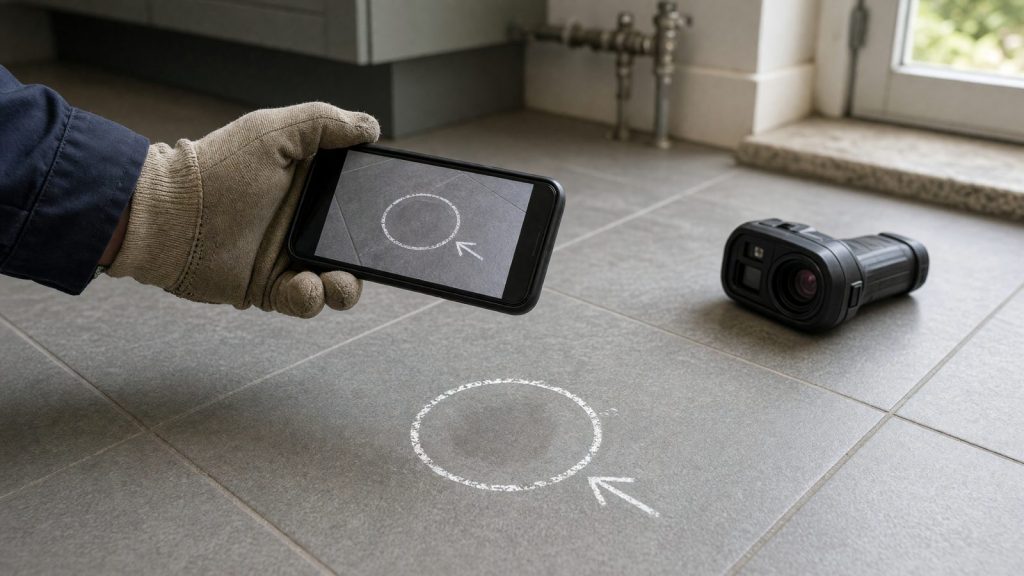
Nothing is marked until two different tests agree. Then the spot gets a mark and a photograph before we go, so whoever opens up later knows where to begin. A written report follows, with the location, methods, readings and photographs. We send it to you as soon as the visit is fully paid. It is set out for a trace and access claim, but only the insurer decides whether a claim is paid.
We can usually repair the leaking pipe too, which saves arranging a second visit to an empty house. Repairs carry a separate quote. If you agree a repair price in advance, it stands only for work finished on the day we find the leak. Repairs are guaranteed for 3 months from the day of the repair, for the new pipework and fittings only. Afterwards, read the meter twice with nothing running to check the leak has stopped, and let the property dry out before anyone moves in.
Where a water company letter started all this, let the company know the pipe has been mended. Some water companies offer an allowance on the bill after a leak is fixed, and each has its own rules, so ask yours what it needs. Keep the report, the repair invoice and your meter readings together in one place, ready for the insurer, the water company or a future buyer.