
A water leak in a new build house: first steps and photographs
If you find a water leak in a new build house, deal with the water first and the paperwork second. If water is pouring out, close the stop tap: in a new home, look below the kitchen sink first, then in the utility room or behind a small panel where the pipe comes in. Keep clear of wet switches and light fittings, and turn the power off at the fuse box, or consumer unit, if water is reaching them and you can get there safely.
Photographs taken now will matter later. Capture the wet area, any stain on a ceiling or wall, the water meter reading and anything dripping, with a coin or a tape measure in the frame for scale, and take more over the next few days if the mark spreads. Jot down when it shows: after a shower, when the heating comes on, overnight, or all the time. Those notes help whoever investigates more than almost anything else.
Talk to the developer's aftercare team first
While the home is new, the developer's aftercare or customer care team should be your first call. Report the leak by email or through their online portal so there is a written record, attach your photographs and keep every reply. Your handover pack and warranty documents should explain how to report a defect and who deals with it, so read them before anything else happens to the pipework.
Ask before anyone opens up a floor, wall or ceiling, your own plumber included, and get the answer in writing. Some developers send their own trades first, and work done without asking can lead to arguments later about who caused what. If the leak is doing damage while you wait, say so in writing and ask when someone can come. Keep a simple log of each visit and what was found.
Where new homes tend to leak
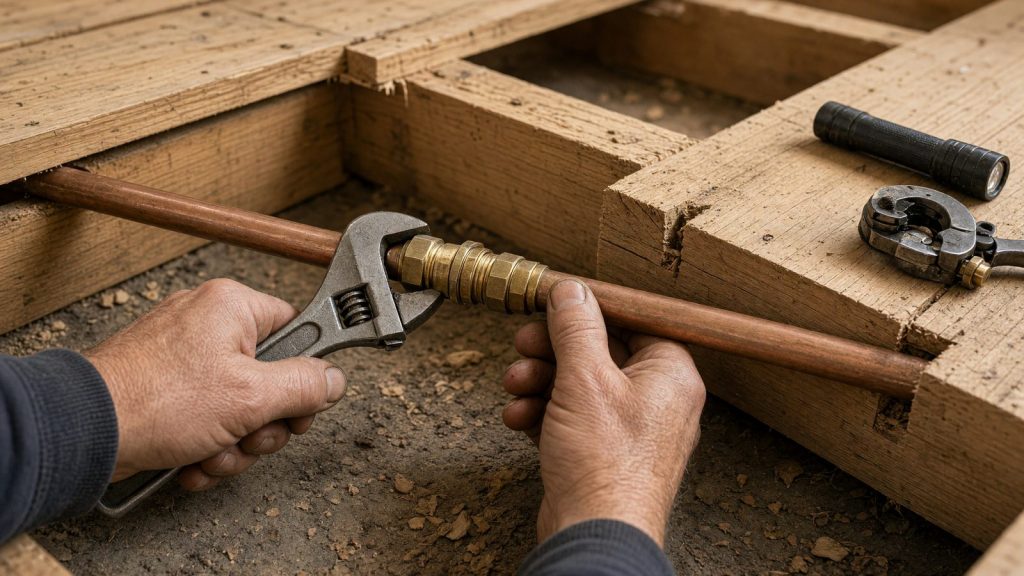
New homes have new pipework, so early leaks usually come from how it was put together, or from later work disturbing it, rather than from age. Plastic push-fit pipe, joined by pushing the pipe into the fitting, is common, and a joint that was not pushed fully home can hold for weeks before it starts to weep. Fixings are the other usual culprit: a screw for a skirting board, a kitchen unit or a shelf can go straight through a pipe in a hollow stud wall or floor.
The supply pipe deserves its own mention. On the estates going up around towns across Cambridgeshire, Essex and Bedfordshire, it is usually blue plastic, laid while roads, drives and gardens were still being built around it. A joint at the meter or the stop tap, or a pipe nicked during landscaping, may only come to light when the water company writes about continuous use or the meter keeps turning with everything off.
Shower trays, wastes and sealant that opens up as the house settles
Push-fit joints under sinks and baths and behind toilets
Pipes caught by screws or nails in stud walls and floors
Underfloor heating manifolds, and loops set in a new concrete floor
The new supply pipe between the meter and the stop tap
Washing machine and dishwasher connections
Is it a leak or the house drying out?
Not every damp patch in a new house is a leak. Fresh plaster, concrete and screed, the cement layer under the floor finish, hold a great deal of water when a house is finished and give it off for months, and modern homes are built to keep draughts out. That moisture often shows as streaming windows, damp in cold corners or mould behind furniture. Opening trickle vents, running extractor fans and drying washing outdoors can make a real difference.
A leak tends to behave differently. It sits in one place, often near a bathroom, kitchen or heating pipe, and it grows or returns after the same activity each time. The meter can help settle it: with every tap and appliance off, it should stand still. If it creeps forward and then stops once the internal stop tap is closed, water is getting out somewhere inside the house.
When an independent survey helps
Sometimes the developer's trades cannot find the leak, or they find one and the problem comes back, or there is disagreement over whether it is a leak at all. That is when an independent survey is worth having. Our job is to find where the water is coming from and put it in writing. Who should pay is a matter between you and the developer, or your insurer, and not something we decide.
Let the developer know before you book us, and tell us the house is new when you ring. If someone else is paying, tell us when you book. We need to reach every room, the meter and the stop tap, and the visit is booked as half a day or a full day, depending on the job. A survey also helps once the home is older and its aftercare has ended, or when an insurer wants evidence before a trace and access claim goes further.
Finding it without lifting new floors
Nobody wants new tiles or engineered wood lifted on a guess. The search starts with readings that narrow things down. A moisture meter maps how far damp has spread from a stain, and pressure testing splits the pipework into parts, such as the supply pipe, the hot and cold pipes and the heating, so we know which one is losing water before we hunt for the exact point.
Thermal imaging follows warm pipes and underfloor heating loops through a finished floor, and tracer gas, a hydrogen and nitrogen mix, finds breaks on plastic pipe and quiet leaks. Under a new drive, we listen to the supply pipe through the paving with a ground microphone and follow the noise to its loudest point. Before we mark anything, a second kind of test has to back up the first. Sleeves, insulation and membranes around a pipe can blur readings, and we tell you when that happens.
The report
After the survey you get a written report with the location, methods, readings and photographs. Payment for the visit comes first, in full, and the report follows. Developers, warranty providers and insurers each handle a claim their own way, and the report gives all of them the same facts to work from. Open up at the mark first. Our readings point to the spot; seeing the damaged pipe is what confirms it.
If we repair the pipe, the repair is quoted separately and guaranteed for 3 months, covering the pipework and fittings we install. You may prefer the developer to repair it, opening up at our mark. If so, no find, no fee on home water leaks will not apply, because it needs you to ask us to open up and repair too. Either way, file the report with your photographs and emails. If water has damaged the house, tell your home insurer early, even before the cause is known.